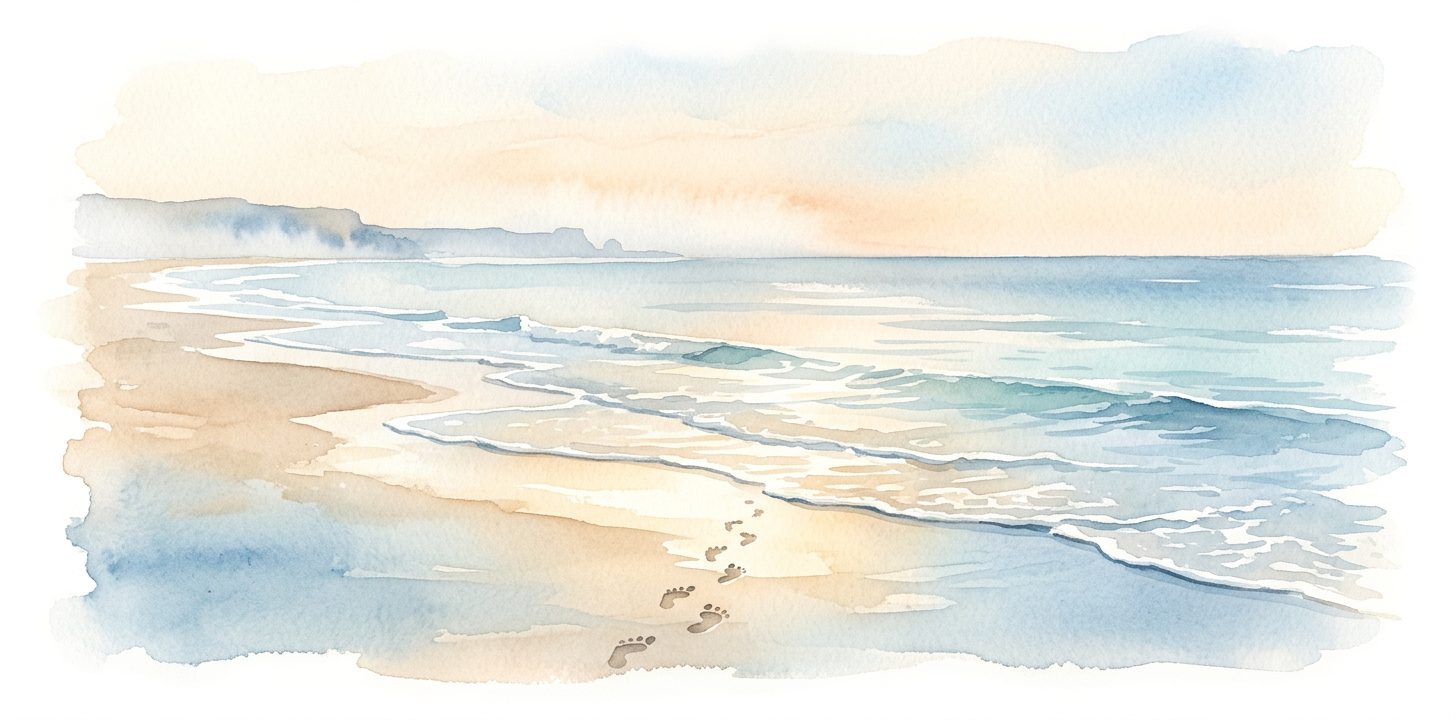
Dreaming of the sea and shore: where solid ground ends and something alive begins
“On the shore, between two worlds, you stand — and both already know your name.”
There are dreams from which you wake with damp palms and the smell of salt. The sea comes to us with such insistence, as though it needs to be heard at any cost. There is a reason for that insistence: in a dream, the sea speaks of more than a summer memory or the childhood sound of waves.
The shore is perhaps the most precise metaphor a sleeping mind can draw: the line where the solid ends and the living begins, where what we know about ourselves stops and what we have not yet dared to know begins. Consciousness is the shore — with its familiar contours, its sun-warmed sand, its remembered footprints. The sea is everything else: feelings that are waiting, impulses we hold in check, truths we are not yet ready to speak aloud.
When you see the sea in a dream, your inner world is inviting you to the boundary. Not to frighten you. To show you. Sometimes a moment with these words is enough for that boundary to take shape inside you: one step on wet sand, and beyond it, what you have long meant to know.
Standing on the shore, afraid to enter
You stand at the edge. Beneath your feet, wet sand that gives slightly with each step. Ahead, the sea: vast, alive, deep blue or grey-green. It is calling. Something in it feels familiar, almost like home. But you do not enter. You stand. You watch. A wave rolls in toward your feet and retreats, as if testing your readiness.
This is a common sea-dream scenario, and a deeply honest one. It captures precisely how we most often live at the edge of what matters: almost decided, almost about to step, then drawing back again with the wave.
Your Inner Child speaks through this image: the part of you that once knew how to throw yourself into the water without a second thought. But the Protector stands beside it: the one that learned caution. The one that learned to check the depth first. The one that remembers, dimly and from long ago, how painful it can be to enter the unknown.
The Protector is not your enemy. It genuinely wants what is best for you. But sometimes its caution becomes a wall between you and what your soul has long been ready to receive. And so you stand on the shore. And the sea waits.
The details here change everything. If the sky above the sea is bright and clear, the fear is there, but it is not about real danger; it is the habit of mistrusting yourself, not a signal to retreat. If the horizon is hung with cloud, perhaps you sense that the moment has not yet arrived, and that too may be true. If someone is standing beside you, that person matters: perhaps they are connected to the very thing you have not been able to step toward. If you are alone, the decision comes from within, without anyone’s help, and that is its real worth.
The temperature of the air is part of the message. A warm shore says the conditions for entering are there. A cold, piercing wind says the opposite: perhaps something outside is genuinely holding back your movement right now, and that deserves respect rather than dismissal.
Ask yourself: “What am I turning my back on, and what am I facing? What is holding me: reasonable caution, or the habit of mistrusting my own desire?”
Before your next sleep, you can allow yourself this image: imagine you take one step, only one, and the water touches your feet. Simply feel the temperature. That is enough. There is no need to go all the way in. One moment of contact is enough.
Astrological note: Dreams of standing on the shore often arrive when transiting Neptune aspects the natal Moon or Ascendant, especially in tense aspects. This is a time when the unconscious calls with particular insistence, while the habitual self is not yet ready to release control. Cancer and Pisces are the signs most sensitive to this symbol. Look at the natal chart too: a Moon or 12th-house ruler in tense aspect with Saturn often creates an inner “guardian on the shore,” the one who watches to make sure you do not go in too deep.
Swimming in a gentle sea
You are already in the water. This matters: you have already entered.
The sea is warm. The waves are soft, almost lullaby-like. The water holds you easily, without effort on your part, without struggle. You swim or simply rock on the surface, and something inside relaxes in a way it has not relaxed in a long time. There is no anxiety here, no hurry. Only water, sky, and that dissolving sense: I am home.
To enter the sea is already a decision. An act of trust. In this dream, your Creator steps forward: the part of you that cannot live only on the surface. It needs depth, immersion, contact with what is alive. When the Creator speaks, it speaks quietly and with certainty: You are already inside. You have already allowed it. Now simply be here.
A gentle sea speaks of an emotional environment that nourishes you, not one that depletes you. A part of your life is feeding you right now. A part that gives strength rather than taking it. Your unconscious is inviting you to notice that, and perhaps to receive that nourishment fully rather than in small polite sips.
The temperature of the water is the temperature of your emotional state right now. Warm, almost hot sea: you are in an environment that accepts and supports you completely. Slightly cool, invigorating: something alive and new is entering your life, refreshing it, awakening it.
How you hold yourself in the water speaks the language of the dream too. If you swim freely and with confidence, trust in the process is already there, even if not yet conscious. If you simply lie on your back, face to the sky, this is a deeply healing dream image: you are letting yourself be carried. The water holds you. The sky is open. Everything else can wait. In freshwater, this story of trust returns more quietly: dreams of swimming freely in water that simply carries you, where the holding is intimate rather than oceanic.
It matters whether others are nearby. Solitude in a gentle sea is time alone with yourself: a rare and precious gift. If there are other swimmers beside you, you are not alone in your emotional journey, and that too is good.
Ask yourself: “What or who is nourishing me in my life right now, and do I let myself receive that nourishment without guilt or hurry? Can I simply be in what is already good?”
Today, when you are in the shower or the bath, try doing nothing for one minute: not scrubbing, not washing, not thinking about the day’s tasks. Just stand under the warm water and feel it touching your skin. A small but precise reminder to the body: “I know how to receive.”
Astrological note: Swimming in a gentle sea — especially in its almost blissful dream dimension — is connected to harmonious transits of Neptune and the Moon, particularly when they touch the natal Sun or Ascendant by trine or sextile. If your natal Moon or Sun stands in a water sign (Cancer, Scorpio, Pisces), you may see such dreams regularly: they are your natural inner language. Jupiter transiting through the 12th house often brings especially deep and vivid sea dreams, a time when the psyche is ready to expand and to receive.
Storm and overwhelming waves
Everything has been set in motion. The sky has darkened. The wind has risen, sharp, strong, merciless. Waves rise to heights that should not be possible. Thunder. Lightning over the horizon. The sea has become something else: powerful, vast, unpredictable. You are on the shore and watching. Or you are in the water and a wave is crashing over you. Or you are on some vessel and it is listing, and you hold on with everything you have.
A storm is not a catastrophe. It is a cleansing. What you hear in the storm is your Rebel: the part of you that was held back too long, that was told, “Quieter. Calmer. Not so loud. Not now.” And it waited. Then it came at night in the form of a storm.
The Rebel does not want destruction. It wants honesty. The Rebel wants what is truly happening inside to be named for what it is, even if only to yourself, in private. A storm in a dream is emotion that has overflowed its banks. It is something that was accumulating in silence, in politeness, in patience, and that now demands space.
The most important detail: where are you during the storm? On the shore, in safety, watching: you take in the storm from a distance, and in that distance there is wisdom; you are not yet swept up in the force of it. In the water, swamped by waves: you are in the middle of an intense emotional process; it is moving, it is real. On a ship: your self, your structure, is being tested. Is the ship holding? If so, you are managing, even when it does not feel that way.
Lightning in a storm is sudden clarity. Sometimes in the very darkest moment, a flash lights up what was invisible before. What did the lightning light up in your dream? Try to remember that moment; it may be the most important thing in the whole dream. With a hull around you, the same weather becomes the dream where the storm rocks the ship.
Ask yourself: “What inside me has long wanted to be heard, and what keeps me from letting it speak? Is there someone, or something, I have been telling to be quieter for too long?”
After such a dream, you might find a place: a physical place where you can be a little louder, a little larger, a little more honest with yourself. A forest. A bathroom with the door closed. An empty road. A place where you can let the storm — just a little — come to the surface. Not to destroy. Simply to give it space.
Astrological note: Storms in dreams often appear during powerful Mars or Uranus transits, especially when they aspect the natal Moon, Sun, or Ascendant. This is a time of changes moving faster than you would wish. Scorpios and Aries know these dreams particularly well: the elements are their inner language. Watch the current eclipses too: a lunar eclipse in a water sign frequently brings on this scenario — the storm that is not destruction but renewal. The sea after a storm is always cleaner.
Searching the shore after low tide
The water has receded. The shore is exposed, further than usual. On the wet sand and among the stones, things appear: shells, pebbles of unusual shape, a glint here, an unfamiliar shape there. Perhaps you find an object you recognize, or one that is unknown to you yet feels important. Or you simply wander and look at the ground, and every find seems significant, even when you cannot say why.
This dream has a rich inner texture: it brings many small finds at once. Your Explorer comes forward, alongside the Healer: the part that has long understood that every low tide carries a gift. When the water withdraws, it exposes what is usually hidden. What lay at the bottom is now here, at your feet. And this is an invitation: look. Take it. This belongs to you.
Low tide, in a psychological sense, is the moment when intensity subsides. After tension, after a turbulent period, after a major decision, a pause arrives. And in that pause, if you do not rush to fill it with new tasks, what matters most can come into view: an answer you have long been searching for. An understanding that had no time to take shape. A feeling that has finally found a form.
What you find matters. A shell speaks of completion: once alive, now become form, pattern, beauty. A stone of unusual color carries stability, ground, an anchor you may have long been searching for. An unfamiliar object comes from the depths and has no name yet; there is no need to name it in a hurry, it is enough to pick it up and hold it. If you find what was lost long ago, your unconscious is inviting you to reunite with what was set aside or forgotten.
How do you relate to your finds? If you gather them carefully, you are ready to receive what the inner world offers. If you walk past or do not notice, something is keeping you from taking what is meant for you. Weariness? Mistrust? A sense that you do not deserve what you find?
Ask yourself: “What has recently receded in my life — tension, a relationship, a chapter — and what has it left exposed? What can I finally look at now that the water has gone?”
In the evening, you can take a mental walk along such a shore: slowly, without purpose, simply looking at the ground. What is there? What will you pick up? Let the image come on its own.
Astrological note: Dreams of searching along the shore after low tide often arrive during Mercury retrograde or when the Moon transits through the 8th and 12th houses, a time when inner layers become accessible. This scenario is especially characteristic when Neptune forms positive aspects to natal Mercury: intuition sharpens, and what usually gets lost in the noise of the day suddenly surfaces with unexpected clarity. Virgo and Scorpio are the signs most able to find meaning in what others walk past.
Leaving the sea, returning to land
You turn your back to the sea. You walk away from the water. Beneath your feet, no longer wet sand but dry, then pebbles, then grass. You walk toward a town, a road, toward what is solid and familiar. The sea remains behind you; you can still hear it, but it is fading. Or you can no longer hear it. Or you turn for a moment and look forward again.
This image is rarely discussed, yet it carries a particular honesty. We do not live in the sea. We come to it, and we leave. And how we leave says a great deal about how we relate to our inner life.
What surfaces in this departure is your Warrior: the part of you that knows how to make choices and carry their weight. But the Guardian stands quietly beside it: the part that fears leaving will cost you what matters — that if you turn away from the depth, the depth will forget you, that the everyday will swallow you and there will be no shore, no sea.
Your unconscious is inviting you to sit with a live question: how do you balance the inner and the outer? How do depth and practicality coexist in you, feeling and doing, immersion and engagement with the world?
The important detail: what feeling do you leave with? If it is lightness and satisfaction, you spent as long in the sea as you needed, and now you are ready for land. This is a healthy movement, a cycle. If it is regret or longing, a part of you does not want to return to the ordinary. Perhaps the everyday feels too tight right now. If it is relief, the sea has taken a piece of you, or shown you what you need a little breathing room from. That too is normal. When the return feels more like relief than regret — closer to reaching solid ground after the swamp — you are not abandoning depth, you are completing a passage that had worn you out.
Do you look back? To look back is not weakness. It is a way to keep the connection without losing your forward movement. You can walk away from the shore and carry it with you: in a sensation, in an image, in what you found there and now hold in your hands.
Ask yourself: “Do I give enough time to my inner life, or do I return to solid ground too quickly, before the sea has said everything it wanted to say? And the other way: do I linger in the depths longer than is helpful, avoiding the real world?”
Try bringing back one small thing from the shore — real or imagined: a pebble on your desk, a shell in your pocket, a line or two in your notes. Let it be a bridge between inner depth and outer life, so that one does not crowd out the other.
Astrological note: Walking away from the sea in a dream often accompanies a Saturn transit through the water signs or through the 12th house, a time when inner experience needs to be integrated into the structure of real life. Capricorns and Virgos see this scenario most often: their nature gravitates toward land, toward form, toward the concrete. But for precisely that reason this dream is especially valuable for them: it reminds them that the sea is not a threat but a resource. And that they can walk away from it, knowing it will not disappear.
Whatever the sea showed you tonight, it chose this image, and what you saw is already working inside you. Quietly, like an underwater current. Unhurried, like the tide. You do not need to understand it all right now, and you do not need to make any decisions: it is enough to let this image stay with you, the way the smell of salt stays after returning from the sea.
And every time the sea comes again to you in a dream, it comes with the same unspoken offer: come closer, look, let yourself feel. You already know what to do next. Your sea knows it too, and it knows how to wait as long as needed.