Dreams of a photograph: a stopped moment through which your life looks into itself
“A photograph in a dream is not a piece of paper. It is a small window into one of your ‘thens,’ in which the psyche keeps what you, perhaps, have long not allowed yourself to feel.”
A photograph is a peculiar kind of object in dreaming. It is at once about memory and about the gaze. Someone, once, caught a moment — and now it is there, stopped, unchanging. When the psyche shows you a photograph, it speaks of time, of witnesses, of the truth of the gaze, of that part of your story which is silently kept while you live on. Sometimes the photograph appears in the dream very specifically: an old photo in a frame, a card from an album, a digital snapshot on the screen, black and white, yellowed, cracked. Something from your “then” wishes to meet your “now.”
Such dreams arrive in moments when your present life is ready to see itself a little from a perspective, or when the past is quietly knocking that it is at last time to deal with it.
One or two specific photos from your life surface in memory easily by now: the ones you have not picked up in a long while.
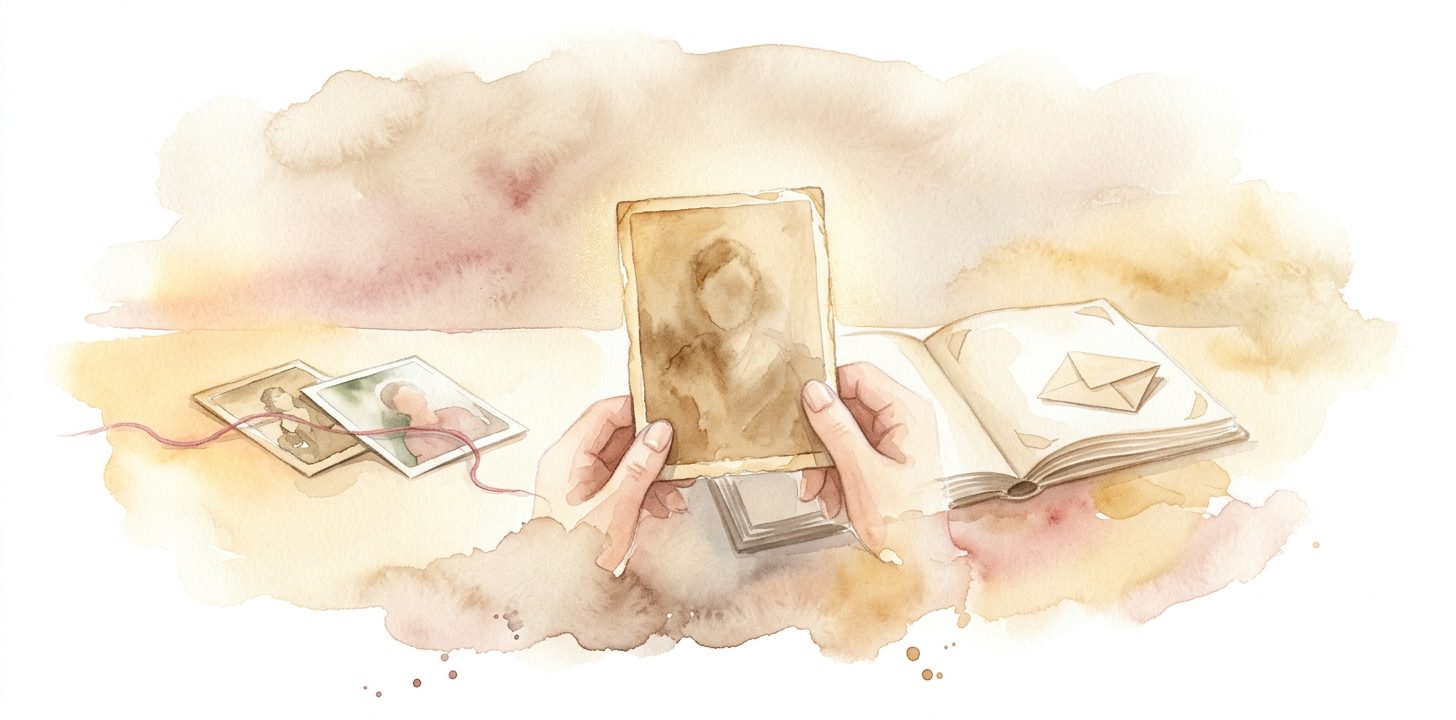
You hold an old photograph in your hands
In the dream you take a photograph: in an album, in a desk drawer, in a box in the attic, from someone else’s hands extending it to you. Black and white, colour, faded, with worn edges. You recognize yourself, those close, the place. Your body holds a particular quiet feeling: I am returning to where I will not be again, but where I was, and that was me.
Behind this frame stands your Inner Sage: the part that knows how to look at its own life a little from the side, to see it as a story and not only as a stream of tasks. Such a dream often comes when a need is ripening inside you to gather yourself in time — to tie “me now” with “me then,” to see the thread between stages, to stop looking at your past as a foreign country. The Sage shows: this was you; and this is also you; and between these “yous” there is a living connection.
If you recognize yourself as a child, there is a tenderness inside for that small figure of yours, and it is worth allowing it to show, without dismissing it as “sentimentality.” If it is a photo of youth, a conversation is now active inside about what you wanted then and what came of it in life; it is worth honestly looking at whether the continuation of this conversation is happening now. If it is a recent photo, you see yourself in retrospect and begin to understand an important moment that was not realized at the time.
Ask yourself: “Which period of my life is asking to come into the light right now — and what can I allow myself to remember from it without dismissal and without idealization?”
Today, take out one real old photo: from an album, from a folder, from your phone. Look at yourself there for two or three minutes. Without analysis. Not “what I was,” but “I was.” The Inner Sage recognizes such returns as respect for one’s own path, and in later dreams more often hands you the photograph that is needed precisely now.
Astrological note: The dream of an old photograph often arrives during transits of Saturn through the 4th or 12th house, during harmonious aspects of Saturn to the Moon, and during periods of Jupiter touching your Mercury. Capricorns, Cancers, and Sagittarians recognize this dream especially precisely. If Saturn is now touching your Moon, the Inner Sage joins the past with the present, and the dream conveys this through a photo in which you recognize yourself and are slightly surprised at how far you have come.
You do not recognize yourself in the photograph
You look at a photo and see a person who is “sort of” you — and “sort of” not. The face is different, the age is different, the expression is unfamiliar. Or someone nearby insists it is definitely you, and you do not feel the recognition. Your body holds a strange “firmware glitch”: this is my snapshot, but the one shown in it is unfamiliar to me.
In this face, your Explorer recognises something: the part that takes interest in all your “other selves” who lived in you in different times and, perhaps, were not given the right to be seen. It comes when there is a displaced facet inside you — a bolder, quieter, more creative, more daring, more living version of yourself you have long not given a voice. The Explorer shows: you have these “I”s inside; they are not foreign, you have simply not met them for a long time.
If the face in the photo is younger and freer, a lighter version of yourself still lives inside you, and it is worth asking what it needs to return. If the face is more grown and more tired, you often do not see in yourself the maturity that has, in fact, already arrived, and it is worth allowing this “elder” side of yours to be. If someone nearby insists “this is you,” there is in reality a person who sees you wider than you see yourself, and it is worth listening. In glass instead of paper, the same non-recognition is the dream where the mirror shows someone who is not you.
Ask yourself: “Which side of mine — bolder, gentler, more mature, more alive — has long awaited that I recognize it in the mirror and say ‘yes, this is me’?”
Today, say to yourself one “unfamiliar” truth: “I know how to be…”, “I am capable of…”, “I want…”, leaning on a trait you usually do not acknowledge in yourself. Without proof. Simply an acknowledgment. The Explorer recognizes such acknowledgments as consent to expansion, and in later dreams more often gives you photographs in which you are a little more than you have grown used to.
Astrological note: The dream of an unrecognized self in a photo often arrives during transits of Uranus through the 1st or 12th house, during aspects of Neptune to your Sun, and during periods of Pluto touching your ascendant. Aquarians, Pisces, and Scorpios recognize this dream especially precisely. If Neptune is now touching your Sun, the Explorer sees the unrecognized facet, and the dream conveys this through a snapshot in which there is more of you than you have yet learned to accept.
In the photo is a person no longer beside you
You hold a photo with someone in it: a relative who has died, a long-lost friend, a former partner, someone who is no longer in your life. In the snapshot they are alive: they look straight ahead, smile, hold you by the shoulder. Your body holds a deep double feeling: the warmth of recognition and at the same time the pain of absence.
At this smile, your Inner Child comes alive: the part that very carefully keeps everything that was once loved. This dream comes when inner work is going on with loss — grieving, accepting, returning love to the one who is no longer here, a farewell that did not happen in time. The Child does not want to upset you; it carefully shows that this love continues to live in you, even if its object is no longer accessible.
If the person in the photo smiles at you, a kind, warm inner image of this person lives in you, and it is worth trusting it, not driving yourself with guilt. If the snapshot is in dark tones, you still carry the weight of the loss without forgiveness, and it is worth allowing yourself to speak gently with this image, even silently. If you put the photo back and walk away, a living, gradual letting go is happening, and it is worth trusting this pace. What sometimes survives the absence at the centre of such a photo is a general warm feeling for the world — the loss having softened, not narrowed, the heart.
Ask yourself: “Which of my departed do I now especially remember not in words but in the heart — and is there something inside I would still want to say to them?”
This evening, if it resonates, light one candle at home and simply spend a few minutes with the thought of this person. You may say silently what you did not have time to say. You may simply be silent. The Inner Child recognizes such quiet meetings as the acknowledgment of love, and in later dreams less often leaves you alone with a sad card in your hands.
Astrological note: The dream of a photo of a departed person often arrives during transits of the Moon through the 12th or 4th house, during aspects of Neptune to your Venus, and during periods of Saturn touching your Moon. Pisces, Cancers, and Capricorns recognize this dream especially precisely. If Neptune is now touching your Venus, the Inner Child meets a beloved image, and the dream conveys this through a snapshot in which the person is still here and still looks at you the way they once did.
A photograph that should be there has vanished or spoiled
You are looking for a particular photo, and it is not there. Or you take it — and it has blurred, darkened, gone bad. A snapshot that was once important has not survived. Around you, perhaps, someone is helping search; perhaps you are alone. Your body holds a particular loss: I cannot confirm to myself one of my own memories.
Out of this loss, your Guardian speaks up: the part that grieves when important pieces of your story are lost or threatened. This dream comes when you have a sense of an important experience “slipping away” — you begin to forget a period of life, lose contact with people who were witnesses, notice that some events are already “as if not mine.” The Guardian shows: your own story deserves preservation; it matters not to lose sight of it entirely.
If the photo is simply gone somewhere, there is the possibility inside to restore the context by other means — through a conversation, a record, a visit, a renewal of ties with those close. If it is spoiled, the snapshot itself cannot be returned, but the memory of what was is still in you, and it is worth maintaining it. If someone says, “there was no such thing,” there is a risk that someone else’s version of your story will rewrite yours; it is worth gently holding to your own.
Ask yourself: “Which period or moment of my life am I afraid to lose from memory right now — and what can I do today so that at least one anchor of this story stays in me for a long time?”
Today, write down two or three sentences about one important period of your life that is dear to you, and save this entry. This is your own digital “photograph,” made from within. The Guardian recognizes such entries as respect for your own story, and in later dreams less often shows you darkened cards.
Astrological note: The dream of a vanished photograph often arrives during tense transits of Neptune through the 4th or 3rd house, during its aspects to the Moon, and during periods of Pluto touching your 4th house. Pisces, Cancers, and Scorpios recognize this dream especially precisely. If Neptune is now touching your Moon, the Guardian fears the loss of memory, and the dream conveys this through a photo in which neither your features nor those of those near you can be made out anymore.
The photograph in a dream is a small but piercing bridge between your times. Through it the psyche speaks with you of what was already and is still alive: of your earlier selves, of those you loved, of your own development, of what is worth remembering.
Allow yourself to return to this bridge more often. Not to get stuck on it, but not to break it off either. To keep the important, to look upon the forgotten, to acknowledge your past as your own. Each time you dream of a photograph, a very quiet part of you says: “this life is yours, and it has snapshots worth taking into your hands sometimes, so as not to forget where you come from and whom you have managed to be.”