Dreams of an empty table: the quiet scene in which what is missing becomes the most audible
“An empty table comes in dreams to those in whom a place for someone or something has already been freed up — the only thing left is to understand whose place it is.”
An empty table in a dream is not a frightening image, and at the same time not an accidental one. A table is a space of meeting: with food, with people, with yourself. When it is empty, it means that in your life right now there is a zone where something has disappeared, not come, or not yet been set out. It can be a sharp lack, or it can be a quiet pause. A dream of an empty table is rarely about food. It is about absence: of people, contact, a plan, meaning, joy, conversation. And at the same time about possibility: the table is empty, so it is free, and something new may one day fill it.
Such dreams come in periods of inner quiet, which is not always calm: sometimes it speaks of loss, sometimes of a pause, sometimes of preparation.
Strangely enough, in this very minute it is easy to listen in to your own inner “room”: which of your tables is empty right now, and whether you want to fill that place with something or let it stay this way a while.
An empty table, you are alone, the plates are empty
You dream of a large table at which no one sits. No plates, no food, no cutlery. The light may be on, but there is nothing for it to reflect. You sit or stand nearby, and it is quiet, but lonely. In the body, a familiar emptiness settles: “no one is waiting for me.”
Behind those empty plates your Shadow appears: the part that carries within it the experience of being abandoned and unlived longing. Such a dream often comes when your reality has lacked a sufficient circle for a long time: those who were close have gone, drifted away, died; a new circle has not yet been gathered. The Shadow does not blame you; it simply shows the fact, so that you see it and do not pretend “everything is fine.”
If the table seems familiar to you, the dream names a specific past in which you miss someone. Allow yourself to grieve those people rather than shaming the grief. If the light is dim, your sadness is not sharp but in the background. Give it attention, or it will turn into fatigue.
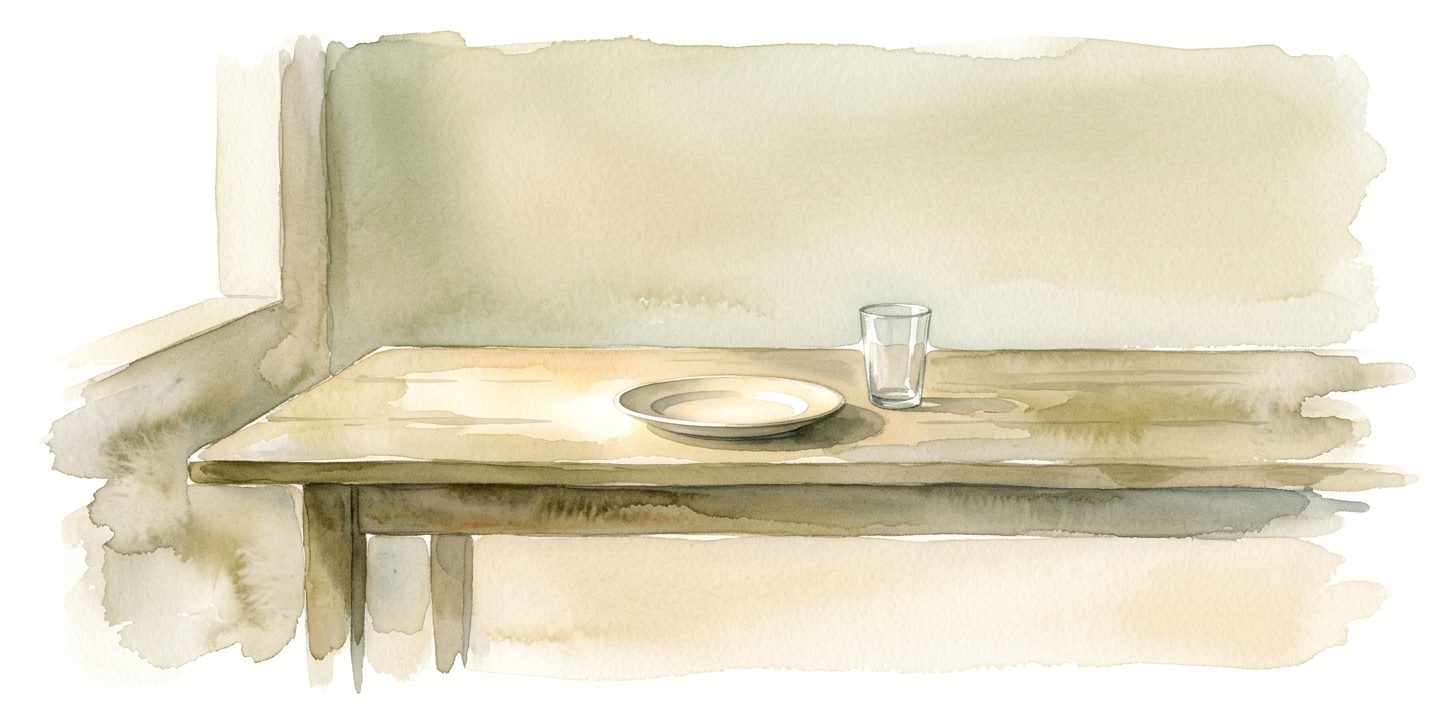
If many people once sat at this table, you are remembering a time of fullness. Ask yourself what from that fullness can be invited into a new form. If you have an idea whom to call but do not call, an inner prohibition on asking is stronger than real loneliness. Gently take it apart. If you stand up and leave the room yourself, sometimes this is more honest than sitting at an empty table. Respect that departure. Named more bluntly, with no dreamer added to the picture, the same scene is an empty plate, an empty table.
Ask yourself: “Whose presence am I now missing in my life — and am I ready to take one step toward the table being set for at least two?”
Today, if the theme resonates, name to yourself one person with whom you want to be right now. Take one small action in their direction: a message, an invitation, even a silent thought sent to them inwardly. The Shadow recognizes such gestures as work with longing, and in the dreams that follow more often sets at least two plates on the table.
Astrological note: A dream of an empty table in solitude often comes during Saturn’s transits through your 4th or 11th house, during its aspects to the Moon, and in periods when Pluto touches your Venus. Capricorns, Cancers, and Aquarians recognize this dream with particular accuracy. If Saturn is now touching your Moon, the Shadow sits at the empty table with you, and the dream conveys this through plates that have no one to serve, although their place is set.
The table after guests have left, empty after a celebration
You dream that there has just been a celebration: laughter, food, people. But now everyone has gone. On the table lie scattered plates, unfinished glasses, crumbs. The house is quiet. You stand in the middle of the room where it was just now noisy. In the body sits a strange mix of tiredness and longing: “it was good, and now it is empty.”
In those leftovers your Inner Child remembers: the part that especially feels the moment when a celebration ends and life returns to weekdays. The Inner Child comes after vivid events: after gatherings, trips, vacations, a big work or family wave. The Inner Child does not want the celebration to last forever; it asks you to honor this “aftertaste,” not to immediately start a new race.
If the silence after the guests is soft, you know how to value this part too. Do not grab for the cleanup right away. If the leftovers on the table are good, the dream reminds you that not everything has to be thrown out at once. Stay a little longer with the traces of joy.
If you feel like crying even though everything went well, this is a normal reaction to contrast. Do not suppress it. If you catch yourself wondering who left first, the dream gently hints at whom, in waking life, it is hard for you to part with. Be tender with yourself about this. If you start cleaning, this too is a way of closing the celebration. Do it slowly and not without pleasure.
Ask yourself: “After what ‘celebration’ am I now in my life — and how can I allow myself the sad ‘after’ without immediately demanding from myself a new ‘before’?”
Today, if the theme resonates, give yourself a quiet hour “after the celebration”: no new tasks, no abrupt transitions. Sit, tea, a window, slow tidying of thoughts. The Inner Child recognizes such hours as respect for contrasts, and in the dreams that follow shows you the emptied table more gently.
Astrological note: A dream of an emptied table after guests often comes during transits of the Moon through your 4th house in tension with Saturn, during transits of Venus touching Saturn, and in periods of Saturn passing through your 5th house. Cancers, Taureans, and Capricorns recognize this dream with particular accuracy. If Venus is now touching your Saturn, the Inner Child feels the “after,” and the dream conveys this through a table on which joy has left soft but clear traces.
You set an empty table in anticipation
You dream that the table is still empty, but you are getting ready. You lay the cloth, the cutlery, set out a vase, light a candle, arrange the chairs. No one is there yet. In the body sits a collected, warm anticipation: someone will come, and I will welcome them.
Here your Guardian speaks: the part responsible for preparation and welcome, able to see to it that by the time a guest or an event arrives, everything is in its place. This dream comes in periods when you are inwardly preparing for something good: for a new meeting, for the return of someone dear, for the beginning of a new stage. The Guardian does not fuss; it brings order slowly and with care.
If you know exactly whom you are waiting for, the dream shows a clear address for your preparation. Check whether your real preparation is aimed there too. If you do not know who will come, yet you are preparing, you are inwardly open to something new. Trust that readiness.
If you check everything twice, in waking life it matters to you to receive the other with respect. Do not forget yourself in the process. If you are calm as you prepare, your steadiness is strong. Notice it as a strength. If you doubt whether you chose the right tablecloth, perhaps in waking life you are still trying to match someone else’s expectations. Set out what you yourself like. When the waiting overruns the arrival, the image turns into the dream where the table is set but no one eats.
Ask yourself: “Whom or what am I inwardly waiting for in my life now — and how can I set the table for it so that it reflects not only others’ expectations but my own shape of warmth?”
Today, if the theme resonates, make one gesture of “preparing the place”: put in order one corner into which you have long wanted to invite someone (yourself, a person, a new stage). Without hurry. The Guardian recognizes such gestures as respect for anticipation, and in the dreams that follow more often shows you a table that will certainly be set for a reason.
Astrological note: A dream of setting the table often comes during harmonious transits of Saturn through your 4th or 7th house, during its aspects to Venus, and in periods when Jupiter touches your Ascendant. Capricorns, Cancers, and Librans recognize this dream with particular accuracy. If Saturn is now in harmonious aspect to your Venus, the Guardian is preparing the meeting, and the dream conveys this through a table on which your care is visible even before the guest arrives.
Leftovers and crumbs, the table already partly cleared
You dream that the table is in an in-between state: part has been cleared, part still lies there — crumbs, unfinished tea, a cup whose contents have gone cold. You stand and look at it. In the body, a thoughtful pause settles: “something was, something passed, and I am here.”
In this dream the voice of your Inner Sage reaches you: the part that knows how to look at the traces of what has happened, without diminishing anything and without taking offense at anything. The dream comes in periods of reflection on what has already taken place: after a completed project, a weathered crisis, a period of life that has come to an end. The Sage does not rush you to clear away or throw out; it gives you time to see what remains.
If the leftovers look cozy, there was much that was alive in the experience gone by. Acknowledge it as part of your story, not only the heavy part. If you want to finish the leftovers, the dream suggests that in the past there is something “not taken” to which you can return. Figure out what exactly.
If you gather crumbs into your palm, your tenderness toward life is alive. Acknowledge it in yourself. If you notice that the tea has gone cold, in waking life there are themes worth returning to before they go cold for good: conversations, plans, letters. If you sit down and simply look, that is a form of meditation. Allow yourself this.
Ask yourself: “What past am I sitting with and looking at now — and which of its ‘crumbs’ am I ready to gather carefully into memory, and which am I ready to calmly clear away, without making a tragedy of it?”
Today, if the theme resonates, devote twenty minutes to the “leftovers on the table” in real life: reread one old letter, look at old photographs, write a short piece about a period that has ended. Without conclusions. The Inner Sage recognizes such minutes as respect for what has been lived, and in the dreams that follow leaves you warm, not sad, remnants more often.
Astrological note: A dream of leftovers on the table often comes during Saturn’s transits through your 8th or 12th house, during its aspects to Mercury, and in periods when Jupiter touches your Saturn. Capricorns, Scorpios, and Pisces recognize this dream with particular accuracy. If Saturn is now touching your Mercury, the Inner Sage gathers the “crumbs of the story,” and the dream conveys this through a table on which every small thing suddenly turns out to be meaningful.
A dream of an empty table is not a sign of poverty or loneliness, but a scene in which the psyche speaks about emptiness and its meaning. In it you can see where you have a sharp lack, where a quiet sadness after fullness, where anticipation, and where a quiet reflection on what has passed.
Let these dreams be a pause, not an alarm. Emptiness at the table is not always loss; sometimes it is a free place prepared for something new. And each time your dream leaves an uncovered or already-cleared table before you, a very quiet part of you says: “sit a little — and listen for whether this table is waiting for something, or whether it has had enough of what was here, and now you can simply breathe.”