Dreams of losing things: a world where what you need vanishes when you look away
“Things in a dream do not lose themselves. What is lost is what they were quietly holding inside you.”
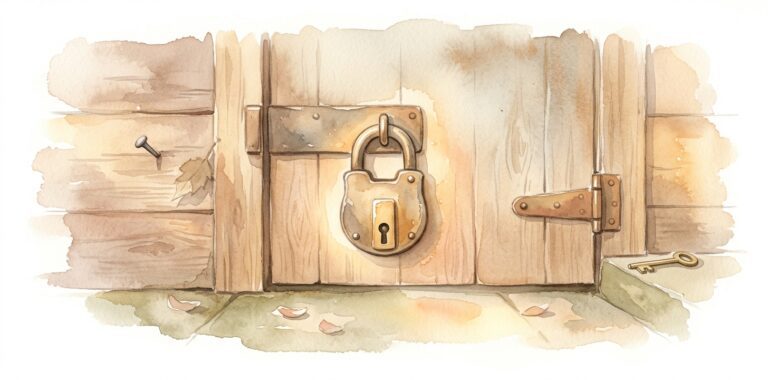
Losing an important thing is a deeply bodily experience. In every culture, people place their supports into objects: into keys, the threshold of home; into a wallet, the relationship with the world; into documents, the name and history. When a thing disappears, more than the thing vanishes: for a moment a piece of the usual order is gone, and in that small hole you can hear how much was bound up with this simple form. That is why the anxiety is so bodily: the body recognizes that what was lost was not an object, but a small part of its familiar order.
In a dream, the loss of a thing comes precisely when something in life stops holding as firmly as before: a role, a relationship, a way of being yourself, a familiar support. The psyche shows this in a language everyone knows: searching pockets, looking under the table, returning to the place where it was definitely there, and still not finding it.
In one such dream, the bodily anxiety was a little larger than the thing itself would warrant. Perhaps you already have a name for the support that has begun to hold a little less firmly.
A wallet, keys, or phone are gone from your pocket
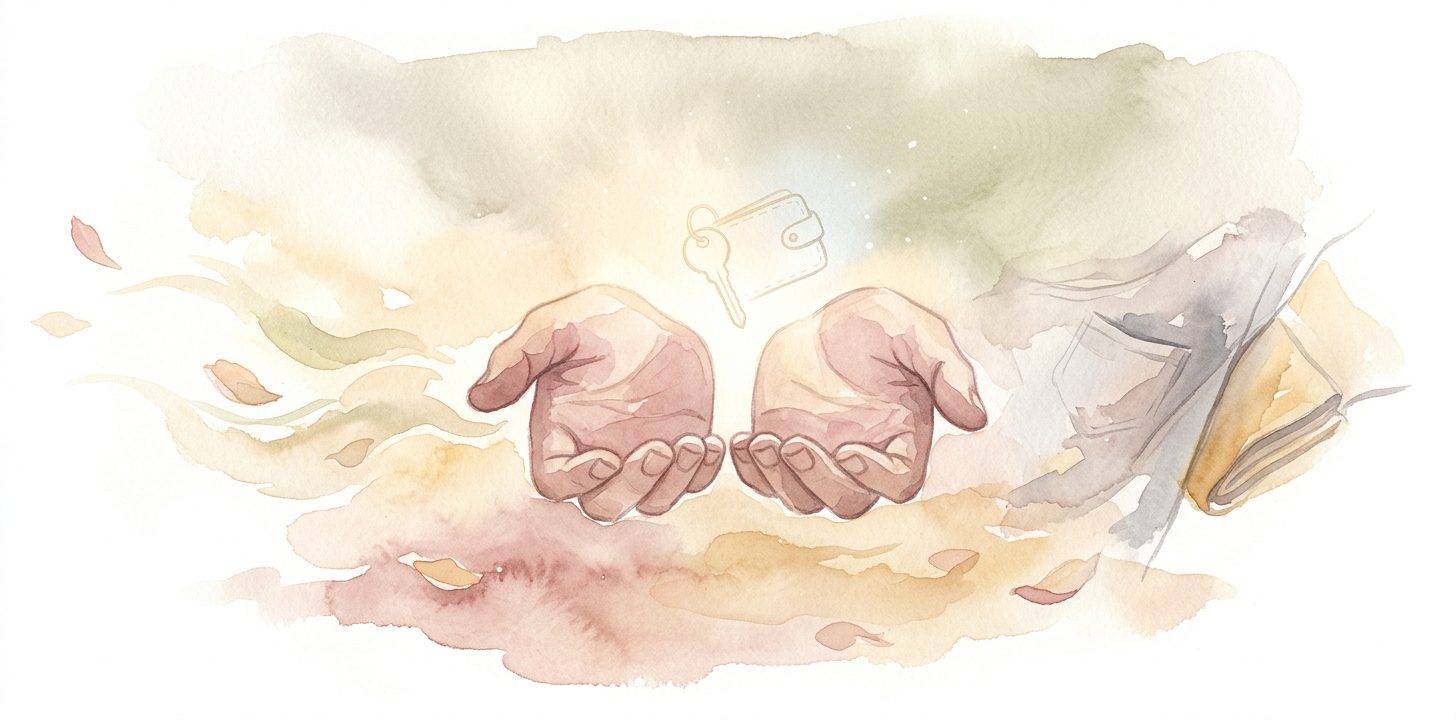
An ordinary day. You reach into your pocket or bag and the familiar object is not there. You begin to search: pocket by pocket, compartment by compartment. Your hands move faster, breathing quickens, a dense knot forms in your chest. Your thoughts circle back to where it definitely was, but memory gives no foothold. What was always within reach has vanished: a key, a wallet, a phone.
Your Guardian feels this absence: the part that keeps safe what you need to leave home, and what you need to step back into it. It stands nearby and quietly counts: every key, every coin, where the document is. When this disappears in a dream, the Guardian shows: it is tired of being the only one who remembers all your supports. By day it often works in the background — the double-check before leaving, the internal list, the low-grade worry that something may be lost. The dream says: the load on it has grown larger than it can carry alone, and the matter is not the real thing — it is that the Guardian holds too much in mind, without respite.
If the object in the dream is very specific, your own, the Guardian is pointing to a specific support in life that has grown difficult: a connection to the world, financial order, an accustomed way in. If what vanished is only “something important, I don’t remember what,” you are in a period when it is unclear which support is being taken from you, and the body reacts to the general background of instability. If at the end of the dream the thing is found after all, the Guardian is checking where your resource still holds, and showing: not everything is lost. The opposite vantage on the same value is the dream where the treasure is guarded, kept rather than vanished.
Ask yourself: “What check have I long been doing alone, on a reserve of attention, and to whom or to what could I hand over even a small part of it?”
Today, choose something you usually check twice — the keys in your pocket, the door lock, the stove — and deliberately check it only once. Once is enough. If this is completely impossible, choose something non-critical. The Guardian recognizes such short pauses as unloading, and in later dreams stages a disappearance less often.
Astrological note: The dream of a needed thing vanishing from a pocket often arrives during transits of Saturn through the 2nd or 6th house, during tense aspects of Mars to Mercury, and during periods of retrograde Mercury. Tauruses, Virgos, and Capricorns recognize this dream especially precisely. If Saturn is now touching your Mercury — the Guardian is overloaded with checks, and the dream shows this as the disappearance of a familiar support.
You search the whole house and cannot find it
You are in your own space, but what you were looking for is not there. You go room by room, open drawers, lift things, look into bags and pockets — no. The house gradually starts to feel strange: as if new corners have appeared in it, corners you had not looked into before. The body grows tired of searching, but you cannot stop: once more, and again, maybe behind this, maybe right here. The longer you search, the more absurd the familiar house becomes.
Your Inner Critic is hard at work in this search: the part that quietly repeats in the background, “you didn’t look well,” “careless,” “you should have remembered.” It knows how to turn an ordinary loss into a personal defeat. By day, the Inner Critic turns even small forgetfulness into a reason for shame, and a simple “where did I leave this?” into a reason for a stern inner report. The dream shows its usual work under a magnifying glass: you are not simply looking for a thing, you are proving to yourself that you are still fine, that everything is in order with you, that control has not been lost.
If you walk through the house calmly and quietly, in life you have the resource to search without self-reproach, and it is worth protecting. If the search turns into panic and the house becomes a labyrinth, the Inner Critic has taken over the scene, and the matter is not the thing but how long you have not cut it any slack. If at some moment you sit down and simply stop searching, a part of you already knows that sometimes not finding matters more than finding at any cost. The same searching, named without disguise, is the dream where you search the house but find nothing.
Ask yourself: “What small forgetfulness in recent weeks has become a large inner reproach for me — and what would change if I let myself be simply scattered sometimes?”
Today, if you forget or lose something, say to yourself once: “it happens.” Without continuation, without analysis, without promises of “I won’t do it again.” The Inner Critic recognizes such short phrases as a clear boundary, and in later dreams turns the familiar house into a labyrinth less often.
Astrological note: The dream in which you endlessly search the house often arrives during transits of Saturn through the 6th or 3rd house, during retrograde Mercury in earth signs, and during its tense aspects to the Sun. Virgos, Capricorns, and Geminis recognize this dream especially precisely. If Saturn is now touching your Mercury — the Inner Critic sets a high bar for memory, and the dream shows how it presses from within.
A thing dear as memory disappears
What vanishes is not something functional, but something dear in itself. A grandmother’s ring, a childhood toy, a gift from someone close, an old photograph. The body reacts not with anxiety about how to live now, but with a quiet sharp ache — like a small death. You search more slowly than in other searches. Sometimes you do not search at all: you simply stand and know that it is gone.
Through this loss, your Healer speaks: the part that knows how to join past and present, that remembers connections the eye does not see. The Healer shows: you have not lost the object, but what you felt through it — a connection to a person, to your former self, to a time when something was simpler, warmer, more your own. The Healer does not dramatize this loss; it gently returns the connection to you as living, not only attached to the thing. The dream says: it is time to see that your bond with loved ones, with the past, with your former self, runs deeper than the object, even if that object was its faithful sign.
If the thing is linked to someone who has passed, the Healer shows that the connection with them is looking for another way to be with you, not only through an object. If the thing is from childhood, a part of you is longing not for the toy itself, but for the self you were at that age — and that longing deserves to be heard as real. If the thing was given by someone close who is alive, the dream hints that the bond with them is now held by something fragile, and it would be good to renew it with a living word or gesture.
Ask yourself: “What connection in my life do I still hold through a keepsake — and how could it go on if the keepsake were suddenly gone?”
Today, in thought or aloud, name the person or period with whom you have a connection held through a thing. Not to evaluate the connection, but to let it be heard. The Healer recognizes such namings as the restoration of a living bond, and in later dreams takes away dear keepsakes less often.
Astrological note: The dream of losing a keepsake often arrives during transits of Pluto or the Moon through the 4th or 8th house, during retrograde Venus, and during her aspects to Saturn. Cancers, Tauruses, and Scorpios recognize this dream especially precisely. If Pluto is now touching your Venus — the Healer restores the memory of connections, and the dream shows this work through a parting with an object.
You give up and stop searching
The search ends not with the thing being found, but with your stopping. You sit down on a sofa, pause in the middle of a hallway, let your hands drop. There is no panic left in the body; only silence. Not joyful, not sad — simply: “well, no.” Sometimes after this something else happens in the dream: something new appears unexpectedly, someone enters the room, you discover that you were in fact looking for the wrong thing.
Your Inner Sage chooses this stop: the part that knows not everything lost in life must be found. Sometimes a loss is an honest sign: what held you is no longer yours. The Inner Sage does not rush you toward acceptance; it simply shows: there is a resource in the body to let go, and that resource most often comes when the searching has run dry. The Inner Sage does not diminish the importance of what was lost. It shows something else: the body knows how to settle even when not everything has been found, and that skill matters more to you now than the contents of a pocket.
If, having stopped searching, you feel a strange relief, there is something in life it is time to let go of, and the body knows this before the head does. If in the silence after the search something new appears, the Inner Sage shows that the loss was not an end but a clearing. If stopping comes hard in the dream and you return to searching again, a part of you is not yet ready to let go — and this is honest information about your pace, not a verdict. On the other side of the same wall, the role flips into the dream where you hide from someone who is searching for you.
Ask yourself: “What do I keep searching for out of inertia, though inside I already know the place is empty — and what could appear beside me if the search were allowed to end?”
Today, leave one planned task unfinished — one that is not critical, but that you are in the habit of completing. Not to force yourself, but to give the body an experience: not everything has to close today. The Inner Sage recognizes such deliberate pauses as agreement with a larger order, and in later dreams brings you not to searches, but to findings.
Astrological note: The dream in which searches break off into silence often arrives during transits of Saturn or Jupiter through the 12th house, during harmonious aspects of Pluto to the Sun, and during periods of active Neptune. Pisces, Capricorns, and Sagittarians recognize this dream especially precisely. If Saturn is now passing through your 12th house — the Inner Sage is teaching the body to let go, and the dream shows this as a calm stop in the middle of searching.
Losing a thing in a dream is not an omen and not a punishment. It is the psyche’s way of showing through which support in you a change is now moving: whether the Guardian is tired, whether the Inner Critic is too strict, whether a bond is held through an object, or whether the time has come to let go of what is no longer yours.
Every thing you ever carried with you was once simply a thing, until you placed something of your own into it. What you placed there stays with you even without it, and that is usually how you know the real support was inside from the start.