Dreams of midlife crisis: when life first asks loudly, “is this all?”
“In the middle of the path, dreams stop showing the future — they start showing the unpaid bills of the soul.”
Midlife is a special period in which the inner person noticeably outruns the outer one. Daytime affairs are still in a familiar rhythm, but inside, uninvited questions keep rising: did I go where I was meant to go? is this the life I wanted? what have I not lived, and is it too late? what in me has not yet been spoken aloud? These questions rarely sound on a Monday morning. They rise at night. Dreams in this period become noticeably deeper: mirrors appear in them with a face that is not yours, forks in the road, forgotten houses of childhood, summary pictures where your life is laid out in things, and not all the things are yours.
Such dreams are rarely even. There is longing in them, and relief, and a quiet rebellion, and a strange sobriety. There is no need to be frightened of them. This is the healthy work of the psyche, which is rebuilding you into a version in which you will be able to live the next decades. If these dreams are ignored, life finds other ways to make itself understood: illnesses, crises, sudden decisions. If they are listened to, most of these processes stay inside and pass more gently.
There is nothing surprising about your night having noticeably changed over the last few months; you can already stop counting these dreams as “age” or “tiredness.”
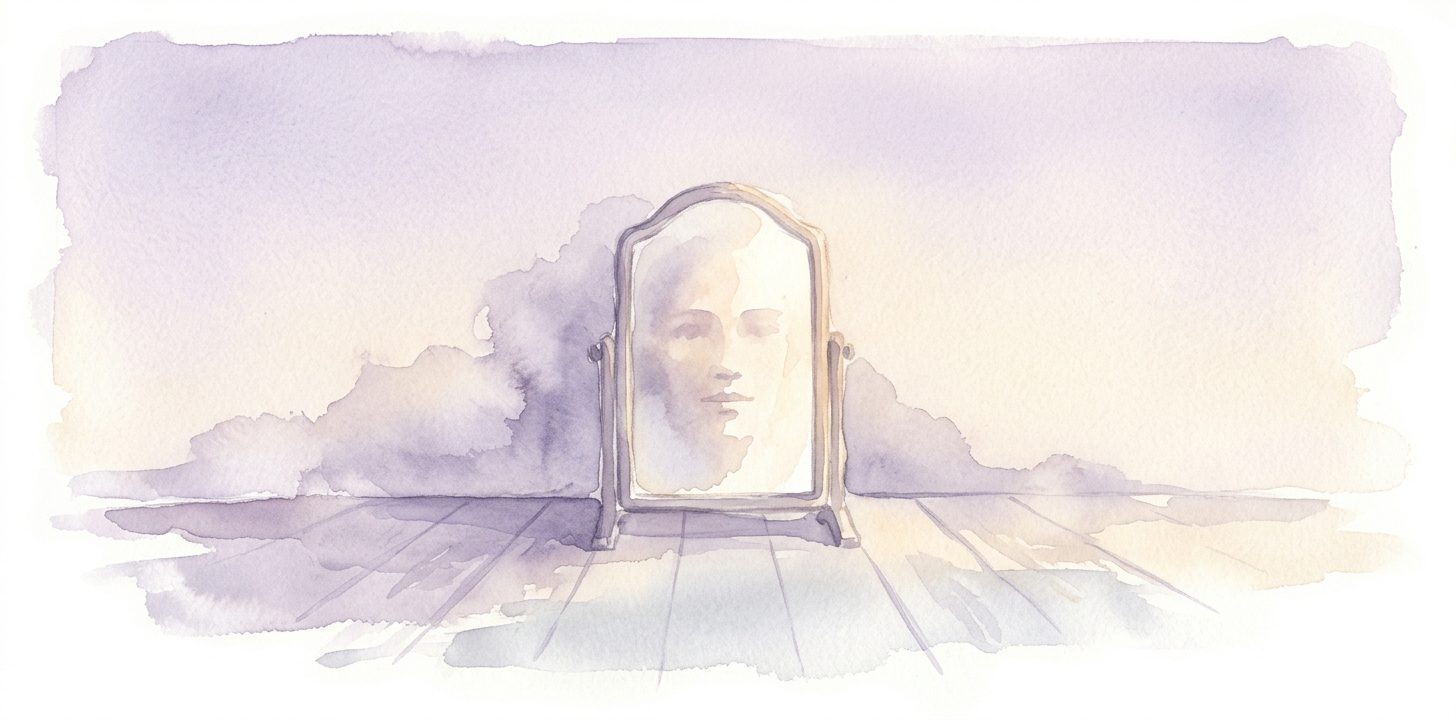
A mirror with a face that is not yours
You dream that you step to the mirror — and see not quite yourself. The face resembles you, but older, or younger, or foreign, or yours but with a different expression. Sometimes you see yourself as a child. Sometimes as your future older self. Sometimes the one you might have been if you had taken another path. In the body sit a strange recognition and awkwardness: “I am me and not me at once.”
Your Shadow speaks here: the part in which your unlived versions of yourself live. In midlife the Shadow grows especially loud not out of pathology, but because your psyche has gathered enough experience to see: “much has not been.” The Shadow does not reproach. The Shadow shows that there are still unexpressed faces in you: the creative, the courageous, the tender, the quiet, the authoritative — the one you long refused to consider yours.
If you see yourself older in the mirror, the dream invites you to a conversation with your future maturity. Ask what it wants from you already now. If you see yourself as a child, the part of you to whom you did not give everything is speaking up. Listen. If the face is entirely foreign, this is not pathology, this is a portrait of “something in you not yet named.” Gently give this face a name, without being frightened by the strangeness. The same uncanny meeting is named directly in the dream where the mirror shows someone who is not you.
Ask yourself: “Which of my faces have I long not seen while awake — and what would this face want to tell me, if I allowed it to speak aloud?”
Today, if the theme resonates, stand for a minute before a mirror and look into your eyes without judgment. Not “how do I look today.” Rather, who is looking out from inside you now. The Shadow recognizes such minutes as consent to the meeting, and in the dreams that follow places a mirror with an evasive reflection before you less often.
Astrological note: A dream of a mirror with a face not yours in midlife often comes during transits of Pluto or Neptune through your 1st or 12th house, during their aspects to the Sun, and in periods when the progressed Sun changes sign. Scorpios, Pisces, and Leos are especially sensitive to such dreams. If Pluto is now moving through your 1st house, the Shadow proposes a new identity, and the dream conveys this through a mirror in which there is at last no room for the old mask, but there is room for you, the one you are only becoming.
A fork, a crossroads, two roads
You dream that you stand at a fork in the road. The roads go off in different directions — into a forest, into a city, into a field, into mountains. You look at them and cannot choose. Sometimes you recognize one of them as your former life, and the other you have never seen. Sometimes both roads are equally foreign. In the body sits a characteristic inner pause: “I no longer want to walk on autopilot.”
At that fork your Explorer pauses: the part that has long watched you walk “on inertia,” and finally considers it time to ask the direct question, “where do you actually want to go?” In midlife this question becomes fitting. The previous twenty or thirty years have already shown much, and you now have enough material to choose not from fear, but from knowing.
If one road leads into familiar scenery, the dream does not say this path is bad; it says it is worth choosing it consciously, not by inertia. If the second road is dark and frightens you, this does not mean it is “not yours”; often important roads begin in shadow. If you stand for a long time, your Explorer does not demand an immediate step; it demands honesty: you no longer have the right to pretend the fork is not there.
Ask yourself: “Which fork in real life stands before me right now — and of my ‘no time to choose,’ which is more: busyness or fear of choosing?”
Today, if the theme resonates, write in one sentence for each of the two roads: “if I go here, I will be…,” “if I go there, I will be…” Honestly. Without romanticizing and without catastrophizing. The Explorer recognizes such sentences as a map, and in the dreams that follow leaves you at a crossroads at dusk less often.
Astrological note: A dream of a fork often comes during transits of Uranus or Saturn through your 3rd or 9th house, during their aspects to the Sun, and in periods when Uranus opposes its natal position (around ages 38–42). Aquarians, Sagittarians, and Geminis are especially sensitive to such dreams. If Uranus is now opposite its natal position, the Explorer places you before an honest question, and the dream conveys this through a crossroads at which automatic mode no longer works.
A return to the house of childhood
You dream that you are again in the house where you grew up. Familiar surroundings. Familiar rooms. Sometimes living parents (even if in reality they are no longer here). Sometimes the same things, the same smells. You walk through the rooms as an adult, recognizing and not recognizing at once. In the body sits a very precise mix of warmth and longing: “I was here, and I am no longer quite from here.”
In that house your Inner Child recognizes: the part that in midlife wants to receive what it did not have enough of in the first twenty years. Not necessarily because childhood was traumatic. Often because any childhood leaves something unlived: something not played through, not said, not loved enough. In midlife the Inner Child suddenly has a chance to be heard — because there is more adulthood in you, and you are finally able to give them what they did not receive.
If the house is bright and calm, you have an inner resource inherited from childhood. Protect and gratefully use it. If the house is frightening, a part of your childhood calls for an adult gaze and a farewell. Look at which theme sounds more loudly than the others. If someone is beside you in the house, the dream shows a key figure of your early experience, with whom it is useful to speak inwardly from today’s maturity. Held in the dream’s nostalgic register, the same return is the house of childhood, old familiar places.
Ask yourself: “What did my small ‘I’ lack in that house — and what can my adult of today give them of what was impossible before?”
Today, if the theme resonates, do one act of care “for the grown-up child within”: allow yourself an illogical pleasure, buy something you could only dream of in childhood, write a short “I am with you” to your inner small self. The Inner Child recognizes such gestures as a real visit, and in the dreams that follow calls you from the familiar room where you were never quite alone less often.
Astrological note: A dream of returning to the house of childhood in midlife often comes during transits of Saturn or Pluto through your 4th house, during their aspects to the Moon, and in periods when the progressed Moon returns to the sign of birth. Cancers, Capricorns, and Scorpios are especially sensitive to such dreams. If Saturn is now moving through your 4th house, the Inner Child waits for your adult visit, and the dream conveys this through a room that you now enter not as someone small, but with the resource of who you have become.
Summing up, things, unpacked boxes
You dream that you are sorting through a flat, a storage space, an attic, a trunk in the loft. You find what you long forgot. Boxes with unfinished tasks, unsent letters, ungiven gifts, things you never used. Or before you stretch out your “results”: a list of what has been done and what has not, arranged on shelves. In the body sits a mix of sadness and composure: “this is my life, and I am at last looking at it directly.”
In this dream the voice of your Inner Sage reaches you: the part that knows how to sum up without self-flagellation and without exaggeration. In midlife this capacity becomes important. It is no longer enough for you to live at random. You have material. And the Sage shows: some boxes it is time to unpack, others to let go, others still to leave lying in the attic as part of the archive that makes you who you are.
If you find something valuable, there is an unlived resource in you to which there has been no chance to return. See what of it can come alive now. If the things are dusty and useless, there are many “social” wishes and expectations in you that came to you not by choice. Honestly let them go. If the results are short, the dream offers not “much” but precision. Perhaps your remaining time is better spent on a few important things rather than on still greater quantity.
Ask yourself: “Which ‘box’ on the inner attic have I long not opened, and what in it is now time either to bring back to life or to thank and let go?”
Today, if the theme resonates, pick one postponed affair from the “unfinished” life boxes — one — and take at least a small step toward it. Not all at once. One. The Sage recognizes such steps as real work with summing up, and in the dreams that follow sets an endless storeroom before you less often.
Astrological note: A dream of summing up and boxes in midlife often comes during Saturn’s transits through your 2nd, 6th, or 10th house, during its aspects to the Sun, and in periods when the progressed Sun approaches natal Saturn. Capricorns, Virgos, and Leos are especially sensitive to such dreams. If Saturn is now touching your Sun, the Sage invites you to an honest inventory, and the dream conveys this through a room in which things were waiting not for you to use them all, but for you, at last, to choose what to use and what to let go.
Dreams of midlife crisis are not a sign of aging and not a crisis in the bad sense. They are an inner restructuring, without which the second half of life would be a continuation of the first by inertia.
Let these dreams be part of your restructuring. They bring to the surface what needs to be seen precisely now. Where you allow yourself the meeting with your unlived face, with the question of real direction, with your inner child and with sober results, the second half of life stops being “the remaining time” and becomes the time in which you, for the first time, truly choose.