Dreams before a major decision: crossroads, doors, bridges
“You already know the answer. The dream doesn’t come to tell you — it comes to remind you: you know.”
There are particular nights — the ones that come before turning points. You’re standing on the threshold of something: resign or accept the promotion, move or remain, say “yes” or “no,” leave or give it one more chance. During the day you weigh and analyze, make lists of pros and cons — and at night your psyche takes the floor. It speaks not in arguments but in images: a road that forks. A door that is sometimes open, sometimes locked. A bridge you’re afraid to step onto. These dreams are not coincidence. They arrive precisely when reason has reached a dead end, and the deeper part of you is offering another way of seeing.
As if even now this answer gently surfaces from inside, as though it had been waiting to be named at last. You already know which decision this is about.
The fork
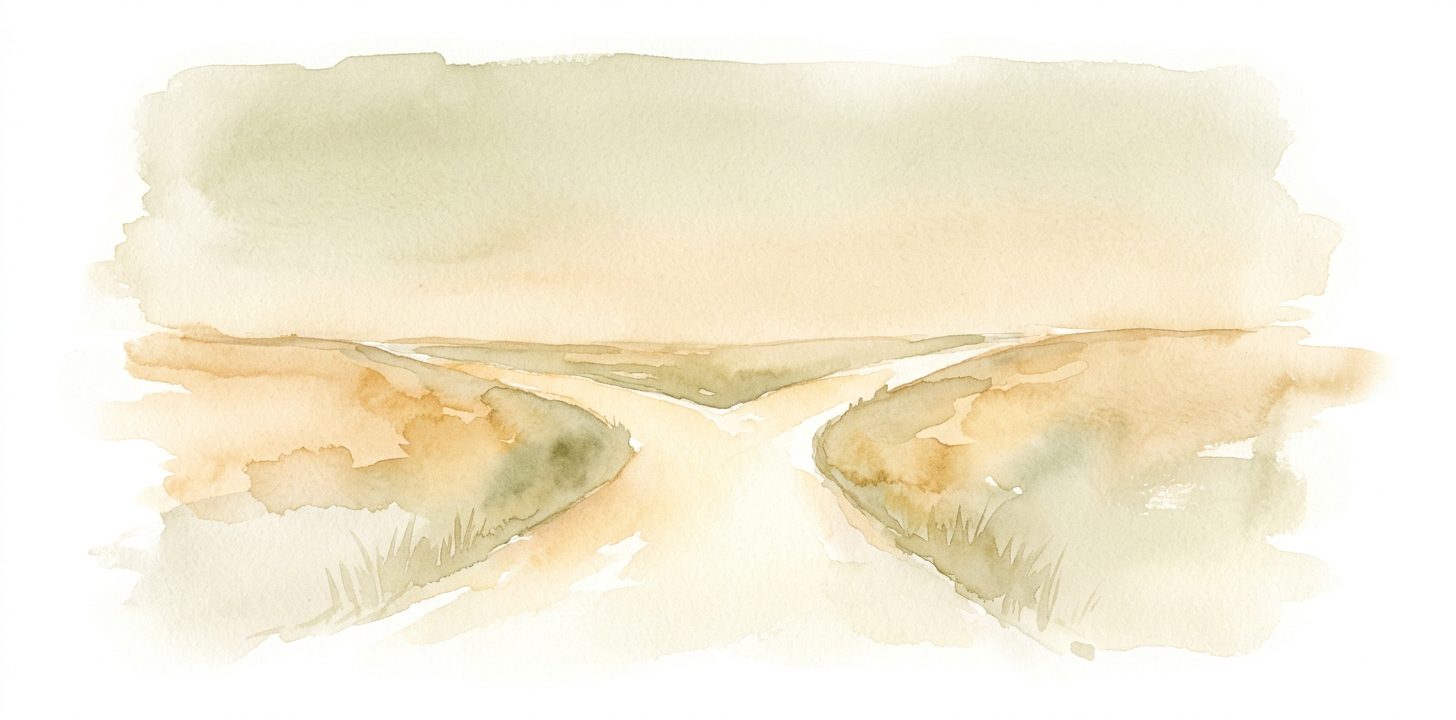
A fork in the road is the unconscious’s most direct language when it comes to choice. Two roads. Three. Sometimes five, fanning outward. And you stand at the branching point, and your legs don’t want to take the first step.
At that fork your Explorer stays beside you: the part that does not hurry but listens attentively to what each road is offering. Every direction is not simply an option. It is a distinct inner pull waiting to be heard.
A wide, well-kept road draws you with what is reliable and familiar: “it’s safe here, I know what lies ahead, don’t take risks.” There is wisdom in this — the wisdom of someone who knows the value of stability. But there is also a shadow side: sometimes “safe” means “comfortably dead.”
A narrow path disappearing into the forest or up a mountain calls with living unknown: “I don’t know what’s there. But I feel — that’s where I need to go. Even if it’s hard, even if it’s unclear — it feels alive.” This is the pull that suffocates in predictability and asks for air.
A road leading back the way you came is the pull of memory: “maybe turn back? It was good there. Or at least familiar.” It isn’t weak — it holds what was precious. But it confuses “it was good then” with “it will be good if I return,” and those are not the same thing.
Pay attention: which road do you choose in the dream? That’s a clue — but not a command. More important still: which road do you reject? Behind it often stands the desire you consider “frivolous,” “selfish,” “impossible” — but which deserves at least to be heard. The rejected road is a voice you’re silencing. And it will return — dream after dream — until you listen.
And if you stand at the fork unable to choose — and this repeats night after night — your psyche is saying something unexpected: “You don’t need more information. You need permission. Permission from yourself — that any choice will be good enough. That you’ll manage on any of these roads. Because it’s not about the road — it’s about who is walking it.” The same intersection, named without ornament, is the dream where you are at a fork with no signs.
Ask yourself: “Which road am I rejecting in the dream — and isn’t that where a voice lives that I’ve long refused to give the floor to? And what do I actually need: an answer, or permission?”
Try telling yourself before sleep: “I allow myself to know. Not to think — to know. Show me where my path leads.” And let go. Don’t wait for an immediate answer — it may not come as a picture but as a feeling: in the morning you’ll wake up and sense a slight lean toward one side. Barely noticeable, like the tilt of a ship. Trust it.
Astrological note: The fork as a dream image is activated by Neptune transits to personal planets (blurred choice), by a progressed Sun changing signs (once every ~30 years — a shift in life direction), and by eclipses on the 1/7 and 4/10 house axes. If you’re a Libra — the sign of eternal weighing — these dreams feel almost native to you. Sagittarians and Geminis also see forks more than most: for them, the question “where to?” is one of the central questions of their lives.
The door
A door in a dream is one of the most precise symbols of possibility. It stands before you — and whether it is open or locked, wooden or steel, familiar or utterly foreign, determines the message your psyche is carrying.
An open door is an invitation. Something in your life is ready to receive you, if you decide to step through. It might be a new job, a new relationship, a new city, a new version of yourself. The door is open — the threshold is clear — and the only thing required is to cross it. Ask yourself: “What is stopping me? What am I afraid to see on the other side?”
A locked door you can’t open is a more complex symbol. Your Guardian speaks here: the part that decides what you may and may not do right now. Sometimes the Guardian is wise: it protects you from what you’re not yet ready for. But sometimes the Guardian is simply an old habit: “Not here. This isn’t for you. You’re not cut out for this.” And then the question worth asking is: “Who locked this door — life, or me?”
Many doors — a corridor with dozens of doors on both sides — reflects the feeling of too many options. Paradoxically, this can be just as paralyzing as having no choice at all. When there are too many doors, the inner part that weighs every option overloads, and instead of a decision you get a standstill. The message of this dream: “Don’t try to look behind every door. Choose one — any one — and walk in. You can always walk out and choose another.”
A door without a wall — a strange but common image: a doorframe standing in empty space. You could walk around it — but something draws you to pass through it. This is a symbol of inner ritual: sometimes change requires not a real barrier but a symbolic act of crossing. You don’t need to go around your decision — you need to pass through it. Consciously, with intention. What this image often demands of the dreamer is doing it seven times, long persistence — the threshold yielding only to the hand that keeps coming back.
Ask yourself: “What kind of door stands before me right now — open, closed, ghostly? And who locked it — life, or I myself?”
Try a visualization before sleep: picture a door. What does it look like? What’s behind it? Place your hand on the handle. Feel its temperature. And say: “I’m ready to see what’s behind this door.” Don’t open it — just fall asleep with your hand on the handle. Your unconscious will open it for you when the time comes.
Astrological note: The door as symbol is linked to Pluto (irreversible crossing), Jupiter (expansion into new territory), and the 8th house (transformation through threshold). Pluto transiting the cusp of any angular house (1, 4, 7, 10) — these are the moments when doors in dreams become particularly vivid and significant. Scorpios tend to see doors as locked — for them, every transition passes through the death of an old self. Sagittarians tend to see them wide open: they are called by what lies beyond the horizon.
The bridge
A bridge is perhaps the most stirring of all the symbols of decision. Because a bridge isn’t simply a choice. It’s a crossing. Irreversible, visible, suspended above the void.
A solid, wide bridge you walk across with confidence — a sign that your decision has already, in essence, been made. The inner foundation is there, the path is built, the abyss below — yes, but you’re above it. This dream often comes to people who have already decided but haven’t yet recognized it. Your body, your intuition, your deeper self are already on the other shore — all that remains is for reason to notice.
A shaky, crumbling bridge — a reflection of doubt: “Will it hold? Do I have enough for this? What if I’m halfway across and the bridge falls?” Your Inner Sage speaks here in its cautious aspect — and it is worth hearing, but not letting it block you entirely. A shaky bridge is an honest picture: yes, the crossing won’t be easy. Yes, there are no guarantees. But the very fact that the bridge exists — even if shaky, even if creaking — means the passage is possible. Not perfect, but possible.
A bridge that ends in the middle — an unsettling image, and an especially honest one. Your psyche is saying: “You can’t see how this crossing ends. You have no plan for the second half of the journey.” This is not a verdict — it’s an invitation. An invitation either to finish building the bridge (gather more information, prepare), or — and this is a paradoxical but sometimes the only true answer — to step into the void, trusting that the ground will appear when your foot demands it. Some bridges are built as you cross them.
A bridge over water — adds the theme of emotion to the symbolism of crossing. The water below is the feelings the decision brings: fear, excitement, grief for what you’re leaving. If the water is calm, your emotional foundation is steady, the decision is ripening in a peaceful setting. If it’s turbulent, emotions are overwhelming, and it’s worth taking care of yourself before you step out. Don’t make irreversible decisions in a storm.
Pay attention: what’s on the other shore? If you can see it, that’s a clue to what you’re moving toward. If the far bank is in fog, your unconscious is being honest: “I don’t know what’s there. But I know you can’t stay here.” And sometimes that is enough. When the crossing fails halfway, the same image becomes the dream where the bridge breaks, with no other shore.
Ask yourself: “What kind of bridge do I have right now — solid, shaky, broken off? And what do I see on the other shore — if I allow myself to look?”
Before sleep, say quietly: “I allow myself to cross.” Not knowing where, not knowing how — simply giving yourself permission. A crossing begins with an inner “yes” long before the first step.
Astrological note: The bridge is a symbol of Saturn (the structure of crossing, patience, effort) and Uranus at the same time (the leap into the unknown). A Saturn transit to natal Uranus, or the reverse — this is when bridges appear most often in dreams. Capricorns and Aquarians — the two signs ruled by Saturn and Uranus — carry this theme as one of their central ones: build bridges, or blow them up? The answer, as always, depends on which shore your real life is on.
Dreams before an important decision are not prophecy. They are a quiet conversation with yourself in the only form in which it is possible: through images, not arguments. A fork, a door, a bridge — three ancient ways in which the unconscious speaks about choice. They do not give the answer. They remind you that the answer is already there — you simply needed to see it differently from how you’re used to seeing.
Let these dreams not frighten you, but accompany you. A decision that has already ripened stops being an agony. It becomes — a step.