Dreams of a lost path: when the familiar road stops recognizing you
“A road is lost in a dream not to punish, but to show: you have outgrown the map by which you walked.”
The road is an ancient image of human life. Myths, fairy tales, pilgrimages, epics are built on it: the hero leaves home, walks, strays from the path, finds it again, and returns changed. This image lives in the body from early years: we learn to walk, then to know the way home, then to school, to life, to ourselves. That is why the dream in which a road disappears touches an ancient compass in us: “I know where to go.”
When a road is lost in a dream, it is not a sign that you took the wrong turn in life. More often it is a signal that the old map no longer works: what was once a clear way to go has stopped being clear. The psyche gently removes the signposts so you can hear yourself without their cues. This is unpleasant, but there is a hidden honesty in it: where maps stop answering, real movement begins.
In one such dream, a voice inside found its word: what mattered was not “where to go,” but that something began to sound in you that had not been given a place before. Perhaps it still sounds.
The fog is dense, the road disappears
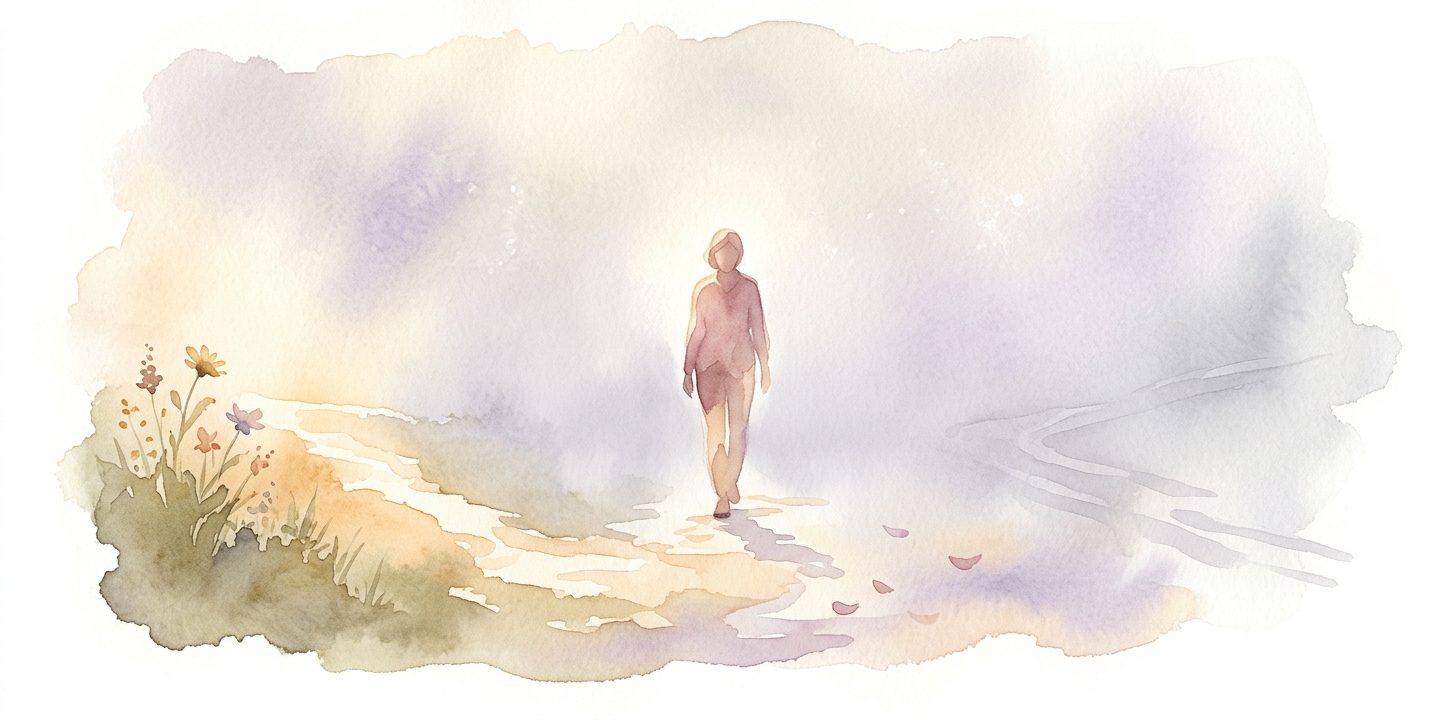
You are walking on a road that a minute ago was clear, and gradually everything sinks into white or gray. Outlines blur, trees and buildings become silhouettes, sounds turn muffled. You stretch out a hand — your palm is visible, but beyond that only thick air. Your feet keep going by feel, and each next step asks for trust, because there is no longer any certainty about what is under your foot.
Your Guardian walks through this fog: the part that in waking life is responsible for reference points, where you are, where you are going, what is ahead, what is behind. When the usual picture of the world blurs, the Guardian stops knowing how to work, and the dream shows this moment directly: it is not doing its job badly, it has simply ended up in conditions where the old ways of checking for safety no longer apply. In life this means much around you has become unclear at once — plans, relationships, inner answers — and the Guardian is honestly reporting: “I am used to seeing, and here there is nothing to see.”
If the fog is soft and warm, in life there is a period now when the uncertainty is not yet hostile; it simply is. If the fog is cold and hard to breathe through, the body is reacting not to the fog itself, but to an inner fear of losing reference points, and it is that fear that asks for support. If voices or footsteps can be heard through the fog, the Guardian is searching for support in the presence of others, and it is worth hearing who is near you in waking life and whom you can ask to walk part of the way with you.
Ask yourself: “What part of my life is not giving clear answers no matter how hard I look — and what would it be like if I allowed myself, there, not to see but to walk by feel?”
Today, once, step out of the house or walk across the room with your eyes closed for five to ten steps. Not as an experiment, but to give the body an experience: it is possible to move without seeing. The Guardian recognizes such small trials as an expansion of its range, and in later dreams panics less often in the fog.
Astrological note: The dream in which a road disappears in fog often arrives during transits of Neptune through the 1st, 3rd, or 9th house, during its aspects to Mercury, and during periods of active Neptune in Pisces. Pisces, Virgos, and Sagittarians recognize this dream especially precisely. If Neptune is now touching your Mercury — the Guardian is learning to work without the usual visibility, and the dream shows this as dense white air ahead.
A familiar place has suddenly become foreign
You are walking along a street you have walked a thousand times. Through a yard you could find with your eyes closed. Through the home town of your childhood. And suddenly — something does not add up. The corner of the house is not where it should be. Around the turn there is a different street. The familiar sign has been replaced by another, and the air no longer carries your scent. A strange disorientation rises inside: have I been here, or have I never been here? And the body loses confidence in its own memory.
Your Inner Child feels this bewilderment: the part that once learned to recognize the world through steady, familiar points, “this is my home,” “this is my street,” “I belong here.” When those points suddenly refuse to recognize you, the Inner Child finds itself bewildered, as if a familiar adult had once looked past without greeting. The dream shows this fine childlike anxiety through the image of a familiar thing that has stopped being familiar: in your life there is now an environment — work, family, a circle of friends, your own role — where something has shifted, and inside, you are not sure whether you still belong there.
If in the dream you try to find the old marks of the place and they disappear one by one, a part of you still hopes the old will return, though deep down it already knows it will not. If in this unfamiliar version of a familiar place you suddenly meet someone new who greets you, this is a signal that the new is already arriving to replace the old, only you have not yet let it in as your own. If you stand frozen in bewilderment in the middle of the yard, the Inner Child needs some adult to say to it: “all is well, here you do not need to remember; we will simply look again.”
Ask yourself: “In what environment in my life have I recently felt that I seem to belong but also not quite — and who could stay near me while I learn to recognize myself in it again?”
Today, walk one familiar route a little more slowly than usual and allow yourself to notice one detail you had not seen before. Not to develop alertness, but to give the Inner Child the experience: a familiar place can be learned anew without getting lost in the process. It recognizes such walks as a gentle return of reference points.
Astrological note: The dream in which a familiar place becomes foreign often arrives during transits of Pluto through the 4th or 3rd house, during its aspects to the Moon, and during periods of active Uranus in earth signs. Cancers, Tauruses, and Capricorns recognize this dream especially precisely. If Pluto is now touching your Moon — the Inner Child is losing old reference points, and the dream shows this through an altered home landscape.
You are at a fork with no signs
You stop because one road has split into several. There are no signposts, each goes off in its own direction. One into a forest, another into a field, a third into a city, a fourth somewhere into the mountains. You look back, but the road behind has already closed: there is no going back. There is no panic in the body, there is a silence of a particular quality — you understand that the choice is real and that it is yours. And no one beside you will hint in which direction it is “right.”
Your Inner Sage stands at this fork: the part that knows there are points in life where signposts are deliberately removed. Not from the cruelty of the world, but because outer signs are superfluous now: the answer lives inside, and it must be heard without others’ cues. The Inner Sage does not hurry you to choose. It shows: the very fact that you are standing at a fork is already a sign of adulthood. A child chooses quickly; an adult knows how to linger and listen to which of the roads quietly answers the body before words.
If one of the roads is faintly “warmer” than the others when you look at it, that is the inner signpost, and it is more precise than any logical scheme. If all the roads seem equally possible, a part of you is not choosing — not from bewilderment but from abundance: you really can walk different paths, and what frightens you is not the lack of an answer but the very scale of freedom. If among the roads there is one you do not want to look at, the Inner Sage shows: that road is about something real, and it holds more truth than you are ready to admit now. The base image at the centre of all such moments is simply the fork — what waiting at any choice finally comes down to.
Ask yourself: “Which of the possible roads in my life is now quietly warmer than the others when I look at it without anyone else’s opinion — and what holds me back from taking even one step toward it?”
Today, ask yourself one important question (for example: “what do I actually want right now?”) and do not answer it with the mind. Simply hold it in your chest for five minutes and notice which part of the body responds. The Inner Sage recognizes such inner listening as your true compass, and in later dreams brings you to the fork not as a dead end, but as the gift of a choice.
Astrological note: The dream of a fork without signposts often arrives during transits of Jupiter or Saturn through the 9th or 1st house, during their aspects to the Sun, and during periods of active Saturn in cardinal signs. Sagittarians, Capricorns, and Aries recognize this dream especially precisely. If Jupiter is now touching your Sun — the Inner Sage offers a choice from a large field of possibilities, and the dream shows this as several equally alive roads.
You walk and walk, and the road will not end
There is a road underfoot. It is straight, with no turns. But however long you walk, the same even stretch is ahead. The horizon does not come closer. The miles do not diminish. The legs grow heavy, a familiar dull tiredness rises in the chest, and at some point a thought arrives: perhaps this road is not meant to end. Or it ends not where you think.
Your Warrior leads you along this road: the part that knows how to hold a course and move forward even when the body is already asking to stop. By day it often does not rest: it is the one that sees projects through, carries obligations, keeps faith with the path once chosen. And when the road will not end in the dream, the Warrior shows you its own overload: it walks not because the path has meaning, but because it does not know how else to be. The dream says gently: walking is not always the same as moving, and tiredness from an endless straight line is not weakness, but a signal.
If in the dream you begin to notice that your legs move on their own, without your consent, a part of your life is running now by inertia, and it is good to see this honestly. If at some point you sit down on the shoulder of the road, the Warrior quietly grants the right to stop, and this is maturity, not defeat. If you suddenly step off the road into a field, into grass, a part of you already knows that real movement is now possible only where there is no beaten track. The same length read as openness rather than as exhaustion is a straight, wide road.
Ask yourself: “Which of my roads am I now walking by inertia, because ‘I must’ and ‘so much has already been covered’ — and what would change if I allowed myself even one hour to be outside it?”
Today, make one small stop in the middle of a familiar task: stand up from the desk, put the phone away, step onto the balcony for three minutes. Not to reset, but to give the Warrior a short pause with no task. It recognizes such stops as respect, and in later dreams leads you along an endless straight line less often.
Astrological note: The dream of an endless road often arrives during transits of Saturn through the 10th or 6th house, during its aspects to Mars, and during periods of retrograde Mars in earth signs. Capricorns, Virgos, and Tauruses recognize this dream especially precisely. If Saturn is now touching your Mars — the Warrior is walking without rest, and the dream shows this as a straight line that knows no end.
The dream of a lost path is not a sign that you took the wrong turn, and not a forecast of a dead end. It is the psyche’s way of showing where in your life a rebuilding of inner reference points is now underway: whether the Guardian is tired in the fog, whether the Inner Child is bewildered in the familiar turned strange, whether the Inner Sage is standing at an honest fork, or whether the Warrior has walked by inertia longer than it should have.
Feet that once allowed themselves, in a dream, not to know the road and still kept walking, remember that freedom longer than the dream itself. And it is precisely where the map ends that the place worth walking to usually begins.