Dreams of destruction: when the old is finally allowed to go
“Destruction in a dream is not a catastrophe, but the psyche’s way of freeing a space that has long been asking for air from within.”
Destruction is among our most charged images: deeply frightening and deeply liberating at once. From time immemorial, people have known something simple: for something new to grow on a waste ground, the old has to be taken apart. The archaeology of any civilization is layers of ruins, under each of which a living life once stood. In myths and legends, destruction is a necessary stage of any great transformation: Babylon fell, Troy burned, the old world leaves to make room for the new. The body remembers this logic: the collapse of the familiar is not always a disaster; sometimes it is the only way the earth receives air.
In a dream, destruction comes in periods of large inner shifts — when the previous form of life no longer holds you, when a role, relationships, habits have stopped feeding you. The psyche often knows this before consciousness does, and begins to visually take apart what is time to leave behind.
Beneath the fear of one such dream was relief: as if something that had been holding on with the last of its strength had finally been let go. Perhaps even now, a quiet “thank you for ending” is sounding inside you.
You watch a building collapse before your eyes
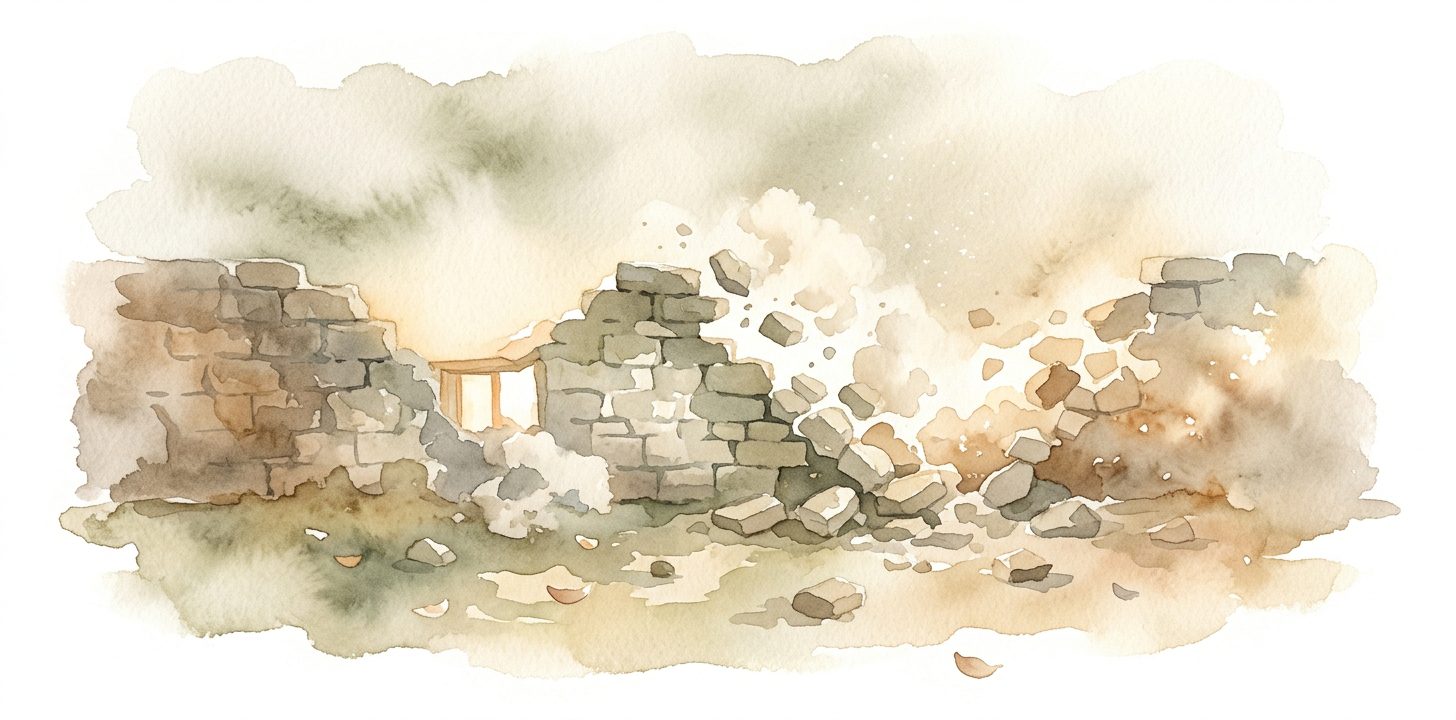
You stand not far off. In front of you stands a house, a tower, a building — perhaps familiar in some way, perhaps not. And suddenly — a muffled crack, a beam falls, one wall tilts, behind it another. Everything folds inward, a cloud of dust rises. You freeze, unable to look away. A cold wave rises in the body, mixed with something else you do not want to name at once. Either horror, or a strange, almost guilty silence.
Your Guardian freezes before these walls: the part that registers loss before consciousness does. It does not like to lose; its work is to preserve. When something in life begins to crumble — a bond, a role, a belief, a former form of yourself — the Guardian is the first inside to notice, and it responds with anxiety. In the dream of a collapsing building, it brings that anxiety onto the screen: here is what was holding — no longer holding — and you can no longer pretend you do not know this.
If the building was familiar to you (your home, your work, a place from the past), the Guardian is pointing to a specific area of life that is now inwardly losing its form. If the building is foreign, unfamiliar, the loss is still moving at a general, background level, and a specific name is yet to come. If you manage to step back before you are caught, a part of you already knows when to step back, and that skill is worth listening to in waking life.
Ask yourself: “What in my current life has long been standing on its last supports — a relationship, a role, a way of living — and what am I afraid to acknowledge: that it is no longer holding, not ‘still holding’?”
Today, inwardly name one thing that has actually ended, although it formally continues. Without deciding to do anything, simply name it: “this is no longer alive.” The Guardian recognizes such honest words as agreement to look at reality, and in later dreams stages sudden collapses without preparation less often.
Astrological note: The dream in which a building collapses before your eyes often arrives during tense transits of Pluto or Saturn through the 4th or 10th house, during their aspects to the Moon, and during periods of active Pluto in Capricorn. Capricorns, Cancers, and Scorpios recognize this dream especially precisely. If Pluto is now touching your Moon — the Guardian is forced to acknowledge the loss, and the dream shows this through walls folding inward.
You break a wall yourself
You hold a sledgehammer, an ax, or simply your own palms. You strike the wall. The first blow is uncertain, the second more decisive. Something flies off, plaster falls. You strike on, with a clear sense of doing exactly what is needed. Sweat, dust, shards, heavy breathing. Inside not fear, but a strange, long-postponed satisfaction: finally.
Your Rebel breaks through this wall: the part that has long wanted freedom and has finally found a way to take it. It does not destroy for the sake of destruction; it takes down what has long been suffocating you from within. The wall in a dream is not an arbitrary wall; it is the image of a specific limit, a rule, a role, a habit that you have already outgrown but went on wearing by inertia. In the dream where you swing a sledgehammer, the Rebel shows: the strength has ripened in you to say “enough” to what has long not fit.
If the wall gives way on the first blow, in reality you perhaps need less effort than you think, and some limits are already ready to leave on their own. If you have to strike long and you do not stop, your inner Rebel is enduring, but it is worth checking whether you are striking a wall that is no longer yours. If after the obstacle is removed a new space opens and you breathe calmly in it, a part of you is ready for greater freedom than usual life is currently offering it.
Ask yourself: “What old ‘this is how it’s done,’ ‘this is how it should be,’ ‘this is how it must be’ have I outgrown, but still live inside — and where is the blow that would separate this period from the one it is time to begin?”
Today, refuse one rule you once imposed on yourself and have long not examined: a routine call, a habitual stance, an automatic concession. Without making a scene, quietly. The Rebel recognizes such small deliberate demolitions as a reclaiming of your right, and in later dreams more often places in your hands a tool you really know how to use.
Astrological note: The dream in which you break a wall yourself often arrives during harmonious transits of Uranus through the 1st or 4th house, during its aspects to Mars, and during periods of active Uranus in Taurus. Aquarians, Aries, and Tauruses recognize this dream especially precisely. If Uranus is now touching your Mars — the Rebel is given permission to act, and the dream shows this through a sledgehammer in your hands.
Everything collapses on its own, without your will
You did nothing. Touched no one. Everything was standing — and suddenly began to crumble. The ceiling cracks, the wall crashes down, the floor gives way under your feet. You rush about, trying to save at least something — a photograph, an object, another person. But the speed of events is greater than yours. You did not cause this; it came from somewhere inside the building, as if it decided on its own that enough was enough.
Your Shadow rises from this rubble — the part into which you put for years what you did not want to feel. Unexpressed anger. Unlived sorrow. A postponed truth about a relationship or work. It does not vanish from being ignored; it accumulates. And when the pressure grows larger than the holding strength of the walls, it does what it has every right to do: it comes out on its own. The dream of a sudden collapse is its way of showing: bearing it any longer is impossible; something inside asks for air and will receive it one way or another.
If part of the house where you lived collapses while the rest is intact, the breakdown is moving locally, in a specific area, and it is time to name that area. If you manage to carry something important outside, a mature “preserve but do not detain” lives in you, and that skill is working now. If after the destruction it becomes strangely lighter rather than more frightening, the Shadow was truly freeing you, not destroying, and the body hears this before the head does. What is doing the work, when nothing seems to be doing it, is often black as shadow — the dream’s name for the actor whose face the picture refuses to show.
Ask yourself: “What feeling do I now keep in myself for a long time, giving it no room — and how does that feeling signal in the body that it is already at the limit of its patience?”
Today, find ten minutes of silence and honestly name one feeling you have long not let yourself feel: “I am tired,” “I am angry,” “I am sad,” “I am afraid.” Without explanations, without decisions. The Shadow recognizes such direct acknowledgments as letting it in at the table, and in later dreams stages sudden collapses without your consent less often.
Astrological note: The dream in which everything collapses on its own often arrives during tense transits of Pluto through the 4th or 8th house, during its aspects to the Sun or Moon, and during periods of active Uranus squaring personal planets. Scorpios, Cancers, and Aquarians recognize this dream especially precisely. If Pluto is now touching your Sun — the Shadow is coming to the surface, and the dream shows this through a collapse with no visible cause.
After the destruction — a clean, empty place
What was collapsing has already collapsed. The dust has settled. The stones are cleared, the debris carted away. You stand on an empty place where something was just recently, and for the first time in a long while there is nothing in this space. The air is cool, the light even. You do not yet know what will be here. But here — there is room. And this, to your own surprise, does not frighten.
Your Healer breathes in this empty place: the part that knows how to be in the silence between an end and a beginning. It does not hurry, does not demand an immediate plan, does not push you toward the next project. It knows: between what has gone and what will come, there is always a pause, and if that pause is not given, the new is built on the old foundation and inherits the old weight. In the dream of a clean empty place, the Healer gives you the experience of this pause: simply to stand and breathe on land that is not yet asking anything of you.
If you feel a calm silence and are not in a hurry to put anything in place, the Healer is leading now, and it matters not to fall out of this rhythm in waking life. If you at once begin planning what to build, the habit of being useful lifts its head, and it can be gently asked to wait. If someone comes up and quietly says “let it be so for now,” your inner ally, the one who knows how to value pauses, is speaking, and it is worth remembering. In the family register, the same emptiness held with grace becomes an empty place at the table.
Ask yourself: “What empty place in my life — after a role, a bond, a project, a habit that has gone — am I now too quickly trying to fill with something, instead of staying in it a little?”
Today, give yourself thirty minutes without a plan. Not “doing nothing,” but precisely without a plan: let time go by while you are not managing it. The Healer recognizes such unfilled pauses as respect for the rhythm of renewal, and in later dreams more often leaves you on a clean place without worry about what will be there next.
Astrological note: The dream of a clean empty place after destruction often arrives after the peak of transits of Pluto through the 4th or 12th house, during harmonious aspects of Neptune to the Moon, and during periods of calm Neptune in Pisces. Pisces, Scorpios, and Cancers recognize this dream especially precisely. If Neptune is now touching your Moon — the Healer is holding silence for you, and the dream shows this through a space without a new structure.
The dream of destruction is not a prediction of trouble and not a moral judgment of your life. It is the psyche’s way of showing which inner figure now leads the theme of “letting go of the old”: a Guardian living through loss, a Rebel deliberately clearing a path, a Shadow breaking out without warning, or a Healer knowing how to live in the silence of the freed place.
Each time you remain alive among the rubble in a dream and notice how it grows easier to breathe, something very old in you learns: destruction is not always ruin — often it is air returning to where it had long been absent. And the empty place that opens up after any demolished structure is not a sign of defeat, but the first, still unwritten frame of the next life.