Dreams of public failure: when the stage bares what you carry inside
“Public failure happens in a dream where a doubt already sounds in you that you have not yet allowed yourself to name aloud.”
Public failure is a scene familiar to anyone who has at least once stepped out to others with something of their own: a word, a report, a piece of work, a face. In ancient communities, an unsuccessful speech before the gathering was a serious trial: the speaker who could not hold attention lost not only the voice, but the place in the circle. The body still remembers that ancient arrangement: the psyche responds to the prospect of failing in front of others as if belonging to the pack is at stake.
In a dream, this plot arrives when the attention of others has gathered in life: a project about to be evaluated, a position you have recently taken, an area where you are unsure of your right to be visible. Beneath the plot almost always lies the theme of the impostor: a quiet feeling that you are about to be exposed and seen as the “real,” insufficient you.
The news in one such dream was not about failure, but about how you speak to yourself on the theme of “do I have the right.” And that news is still with you.
You step up to speak, and the words disappear
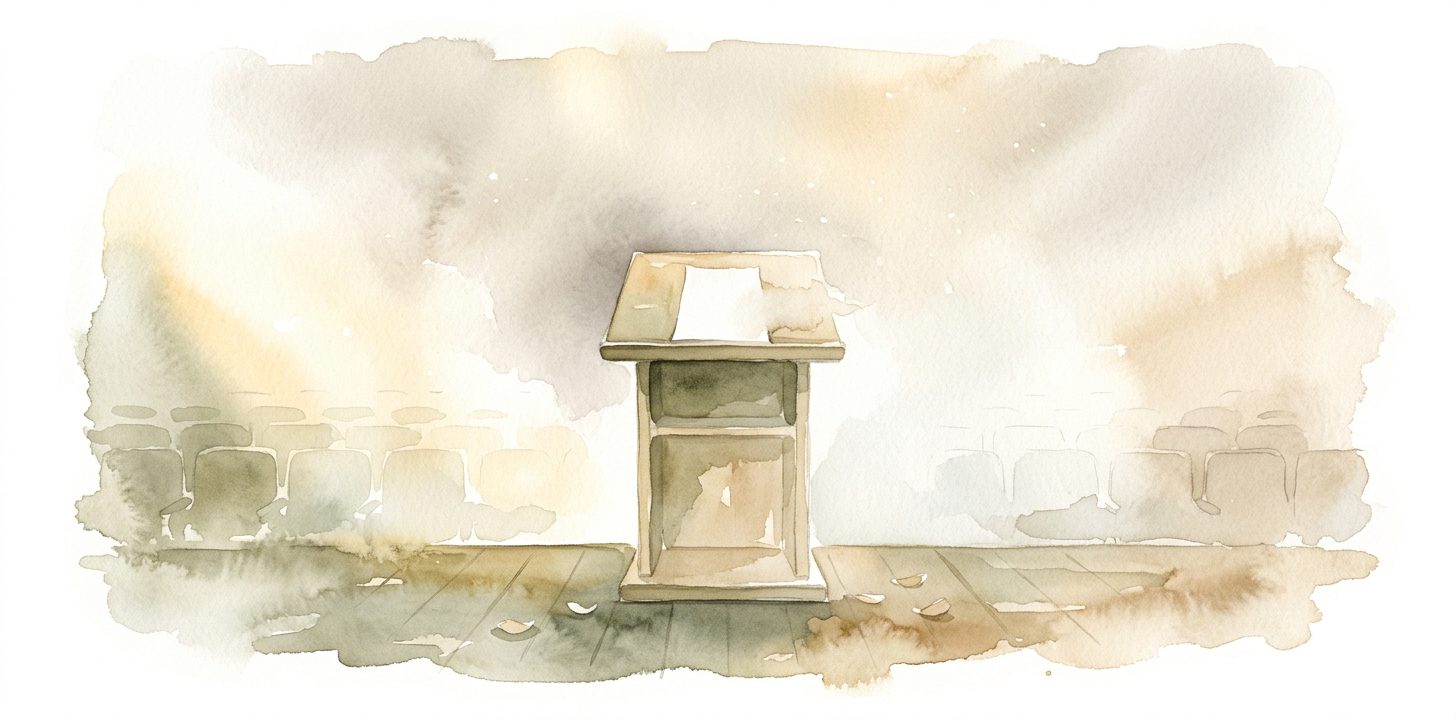
You stand before people. You had waited for this moment, rehearsed at home, held the text in your head. You open your mouth — and find not a single coherent phrase. Memory becomes a white wall, the tongue grows heavy, the throat dries. The seconds stretch beyond what seems possible; someone in the hall coughs, someone exchanges a glance. Your cheeks burn, and you feel: a little more and this pause can no longer be closed.
Your Inner Critic insists in this hitch: the part that knows how to instantly turn any hitch into proof of your inadequacy. It does not wait for the situation to clear; it already knows the verdict. In the dream where the words disappear, the Inner Critic performs its favorite trick: turning a pause — a normal, human pause that happens to everyone — into testimony that you “cannot hold up.” It does this in daytime too, every time you try to say something of your own and cannot formulate it at once, while it is already standing nearby with a ready verdict.
If in the dream you do find one phrase at some point and hold on to it, a part of you knows how to recover, and that resource exists in waking life as well. If the pause stretches endlessly and the hall blurs into a foreign backdrop, the Inner Critic is louder now than your other voices, and it is worth asking inwardly whose voice it speaks with. If someone in the hall nods to you encouragingly, the warm witness in you is alive, and it is worth hearing even against the Inner Critic. The opposite outcome of the same stage is the dream where you speak on stage and the words come.
Ask yourself: “What part of my real words am I now so afraid to say aloud that I prepare a scene of failure in advance inside me — and whose voice from my past delivers the verdict ‘you failed again’ so quickly?”
Today, say to one person one sentence you usually smooth beyond recognition: an honest “I don’t like this,” “I don’t agree,” “this matters more to me.” Not in conflict — in an ordinary conversation. The Inner Critic recognizes such small truths said aloud as the boundary of its right to deliver verdicts, and in later dreams stages scenes with vanished words less often.
Astrological note: The dream in which words disappear in sight of people often arrives during transits of Saturn through the 3rd or 10th house, during its tense aspects to Mercury, and during periods of retrograde Mercury in Virgo. Virgos, Capricorns, and Geminis recognize this dream especially precisely. If Saturn is now touching your Mercury — the Inner Critic is increasing pressure on your voice, and the dream shows this through instant muteness before the hall.
You speak but don’t know the subject
You have said something, and it seems to have gone well. And then someone asks you a simple question — the kind anyone in your role would have to know. And you realize there is no answer. It is not that the wording fails to come — it simply does not exist. The whole picture is suddenly before your eyes: you stand here, under gazes, and do not know what you were supposed to know. Someone in the hall exchanges a glance, someone opens a notebook to record your mistake.
Your Shadow shows in this gap — the part where you once put a quiet doubt: “I did not actually figure this out to the end.” That doubt lives in anyone who occupies a place of responsibility: no one has a hundred-percent coverage of the subject. But the Shadow holds precisely what you refused to acknowledge as yours: moments where you did not fully understand, where you nodded instead of asking again, where you stepped into a role before you had mastered its content. The dream of an exposing question is its way of showing: this is alive, it exists, and sometimes knocks at the door.
If in the dream the question comes from someone senior, an authority, the Shadow shows an old figure before whom you once did not dare to admit a gap. If a child or a random passerby asks the question, your inner knowledge of your own blank spots has long been ready to come into the light without shame. If you suddenly say, honestly, “I don’t know,” that is a mature voice in you, and it is worth noticing how rarely you allow it to sound in waking life. In an arena instead of a hall, the same exposure shows up as the dream where you lost, and everyone saw.
Ask yourself: “In which of my current roles do I quietly carry the sense that I took it up before truly figuring it out — and where am I hiding that sense from myself so it does not break through?”
Today, in one conversation, allow yourself an honest “I don’t know this,” without apologies and without attempts to cover quickly. Not as a demonstration of weakness, but as the acknowledgment of an ordinary human gap. The Shadow recognizes such direct “I don’t knows” as agreement to let it in at the table, and in later dreams stages scenes of exposing questions less often.
Astrological note: The dream in which a question bares a gap often arrives during transits of Pluto through the 10th or 3rd house, during its aspects to Mercury, and during periods of active Pluto in Capricorn. Scorpios, Capricorns, and Virgos recognize this dream especially precisely. If Pluto is now touching your Mercury — the Shadow is returning set-aside doubts, and the dream shows this through a simple question asked in public.
The hall laughs, hisses, or turns away
You said something, made a movement, presented something — and instead of the expected response, the hall begins to make noise. Laughter, hissing, scattered shouts. Or worse, a general turning away — as if they had simply stopped seeing you. The body grows heavy, the knees tremble, you want to vanish. Something very old in the chest whispers: this has happened before, and it ended badly.
Your Guardian contracts before this laughter: the part that is responsible for your place in the pack. It does not know how to be a sage; it knows how to register the signal “you are being rejected” and sound the alarm before it becomes irreversible. In the dream where the hall laughs, the Guardian shows how close to that ancient anxiety you are living now in daytime reality. Somewhere there is an environment where you feel uncertainly accepted — and the body is rehearsing a response to rejection in advance, so you have time to defend yourself if it does happen.
If the hall in the dream is familiar (colleagues, relatives, schoolmates), the Guardian is pointing to a specific group where your acceptance now feels fragile. If the faces are blurred and “everyone in general” is laughing, the anxiety is still in the background, not yet tied to specific people, and the work is with the sensation itself, not a real situation. If among the crowd there is at least one person not laughing with the others, this is the image of an inner ally, and it is worth remembering who in life stands in that place.
Ask yourself: “In what group of people does my acceptance now feel fragile — and what am I doing to preserve it, at the cost of which small daily refusals of myself?”
Today, find one person near whom you do not have to work to be accepted, and spend five minutes with them without an agenda. Not to take something from them, but to give the Guardian the experience: there are environments where you are not driven out. The Guardian recognizes such safe points as a support, and in later dreams stages scenes of a laughing hall less often.
Astrological note: The dream in which the hall laughs or turns away often arrives during transits of Saturn through the 7th or 11th house, during its aspects to the Moon, and during periods of tense lunar eclipses. Cancers, Tauruses, and Libras recognize this dream especially precisely. If Saturn is now touching your Moon — the Guardian is sharpening the theme of acceptance, and the dream shows this through cold laughter from the hall.
You failed — and it wasn’t a catastrophe
You did exactly what you feared most. Forgot the words, got the answer wrong, could not manage the role in sight of everyone. But what happens next is strange. The ground does not open up. No one stood and left forever. Someone apologetically continued the question, someone proposed a break, someone simply turned the conversation. And inside, instead of the expected end of the world, an unfamiliar feeling appears: it is still going on. You stand in your failure and breathe.
Your Inner Sage sees behind this failure: the part that knows how to tell a real catastrophe from its rehearsal. It does not dismiss shame, does not say “nothing happened.” It shows something else: the scale of what you imagined does not match the scale of what actually happens when you turn out imperfect in front of others. The dream of a soft outcome to failure is one of its rare but precise forms of work: to let you live through what you fear in advance, and to see that life does not end after it.
If at some point in the dream you even laugh at yourself, the Inner Sage returns to you the right to be alive, not infallible. If someone supports you with words or a gesture after the failure, your inner warm witness is strong, and it is there outside too, if you look. If you simply stay standing, and it gradually becomes easier, a part of you already knows how to bear your own imperfection, and this skill is growing.
Ask yourself: “What imperfect moment of mine am I now expecting as a catastrophe — and what will happen if it truly does occur, in the most prosaic, realistic scale, without inner drama?”
Today, allow one small visible imperfection: send a letter with a typo and do not resend it, say something not quite smoothly and do not redo it, show up where you are used to “keeping face” a little more tired. The Inner Sage recognizes such quiet permissions to be imperfect as agreement with reality, and in later dreams more often shows that life continues after a failure.
Astrological note: The dream in which failure turns out not to be fatal often arrives during harmonious transits of Jupiter through the 9th or 10th house, during its aspects to the Sun, and during periods of active Jupiter in Sagittarius. Sagittarians, Leos, and Aries recognize this dream especially precisely. If Jupiter is now touching your Sun — the Inner Sage is restoring the scale of reality, and the dream shows this through a soft outcome after a scene of failure.
The dream of public failure is not a sign of real trouble and not a verdict on your work. It is the psyche’s way of showing which inner figure now leads your theme of “I am in sight”: an Inner Critic delivering an instant verdict, a Shadow returning a set-aside doubt, a Guardian protecting a place in the pack, or an Inner Sage calmly allowing you to err in front of others.
Each time you remain standing on the stage after a failure in a dream, something very old in you learns: to be visibly imperfect is not death. And when life next places you in sight, something in you will be a little less afraid — because it has already at least once lived through this fear and remained alive.